Koos Pretorius's Masterpiece North American T-28 Trojan
By Willie Bodenstein
01.11.2026
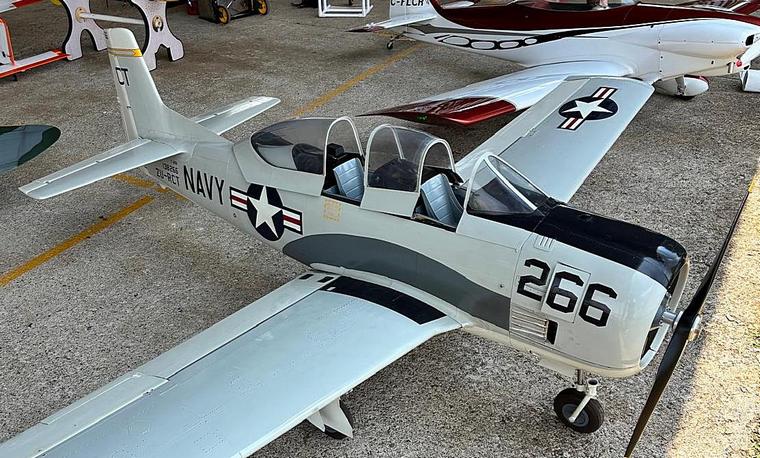
When I arrived at the RMAC Scale Model RC Fly-In on Sunday, two weeks ago, one aircraft immediately caught my eye. It was a stunning North American Aviation T-28 Trojan, a beautifully detailed radio-controlled model that looked every bit as impressive as its full-size counterpart.
The original T-28 Trojan was a radial-engine military trainer developed by North American Aviation and introduced in the late 1940s. It entered service with the United States Air Force and United States Navy in the early 1950s. Although primarily designed as a trainer, the T-28 also proved its versatility in the counter-insurgency role, notably during the Vietnam War. The aircraft subsequently found a new lease on life in civilian hands, where it continues to be flown as an aerobatic performer and warbird.
A total of 1,948 T-28s were built.
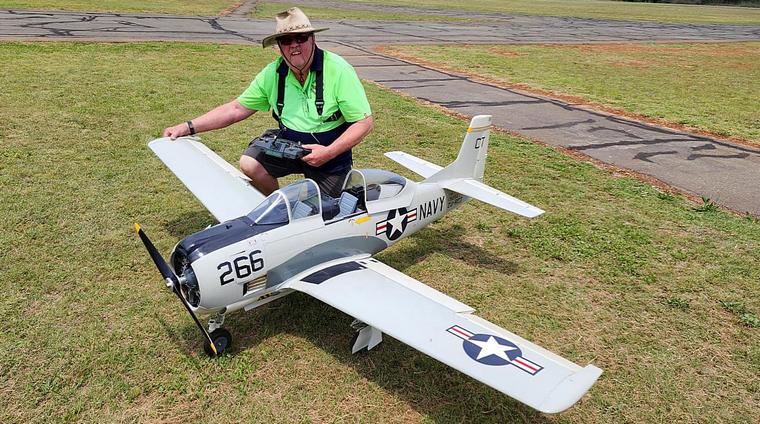
The magnificent model that caught my attention belongs to Koos Pretorius. Scratch-built to a scale of 1:5.3, it is the result of years of research, planning and craftsmanship. Kobus selected this particular scale to accommodate the engine he had in mind for the project.

However, before construction could begin, there was a considerable amount of groundwork to be done. Koos discovered that accurate, commercially available plans were simply not available. For a competition-worthy scale model, where fidelity to the original aircraft is paramount, this presented a considerable challenge.
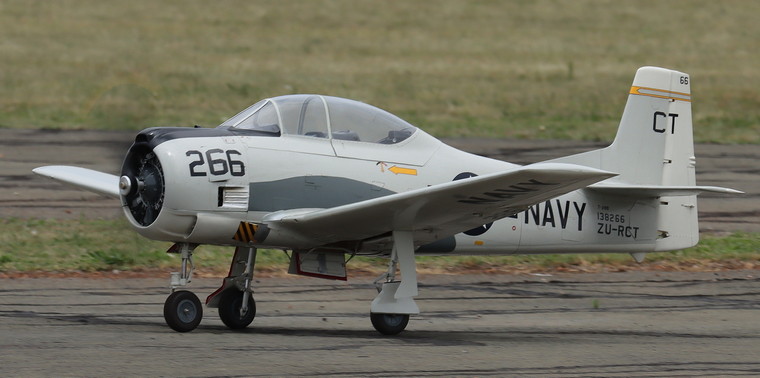
The answer was to create his own drawings from scratch.
From full-size aircraft to detailed drawings
Fortunately, by this time, several full-size T-28s had been imported into South Africa. and he managed to gain access to a disassembled aircraft, allowing him to take measurements of the various components. This involved numerous visits to the airframe and countless hours spent measuring and recording details that would eventually have to be recreated on the model.
The process took several months, followed by more than a year of drawing and refining the plans in his spare time. Only when he was satisfied that the drawings accurately represented the full-size aircraft did he consider them ready for construction.

Competition scale models are judged not only on their appearance but also on how closely they replicate the original aircraft in flight. Accuracy is therefore essential, both on the ground and in the air.
Before producing the plugs from which the epoxy-fibreglass moulds would be made, Koos had the static accuracy of his drawings and design assessed by a friend with considerable experience in judging at world championship competitions.
The assessment ensured that the model would meet the demanding standards expected of a competition-worthy scale aircraft.
Every detail matters
The result is a remarkable example of scratch-building, with virtually every component having been designed and manufactured by himself.
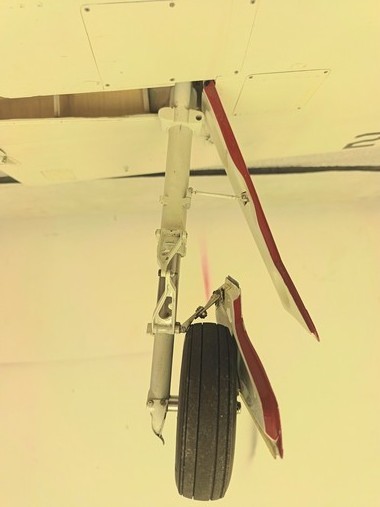 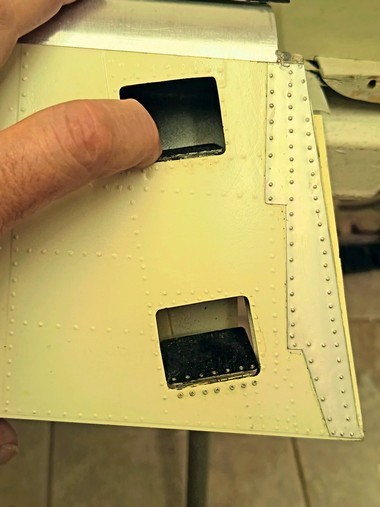
Even the retractable undercarriage had to be made from scratch. No commercially available retracts could be found that would reproduce the correct geometry of the full-size aircraft.
The T-28's wing incorporates eight degrees of dihedral, meaning that conventional 90-degree retracting mechanisms would not provide the correct movement or positioning. The nose undercarriage presented its own challenges, as it too could not simply retract through a conventional 90-degree arc.

The model faithfully reproduces the wing section of the original aircraft, as well as its empennage, offset horizontal stabiliser and rudder.
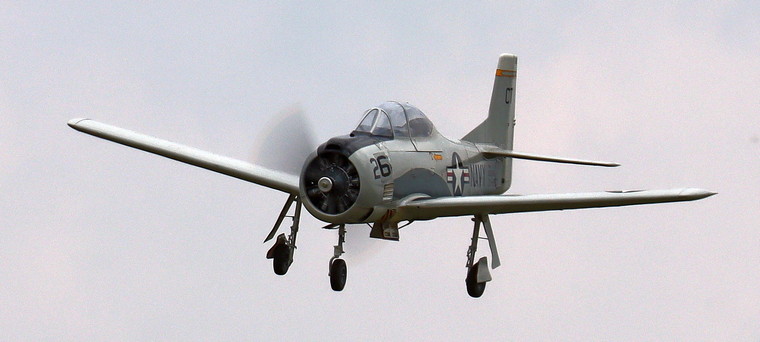
The attention to detail extends to opening sliding canopies and a scale dummy Wright Cyclone radial engine, which he also manufactured from scratch.
It is this dedication to accuracy that sets the model apart. Rather than adapting commercially available components, he went to extraordinary lengths to ensure that the finished aircraft would be as faithful to the original as possible.
A project spanning years
The drawing process began in 2002. Working on the project in his spare time, Koos eventually completed the prototype, which made its first flight in 2006.
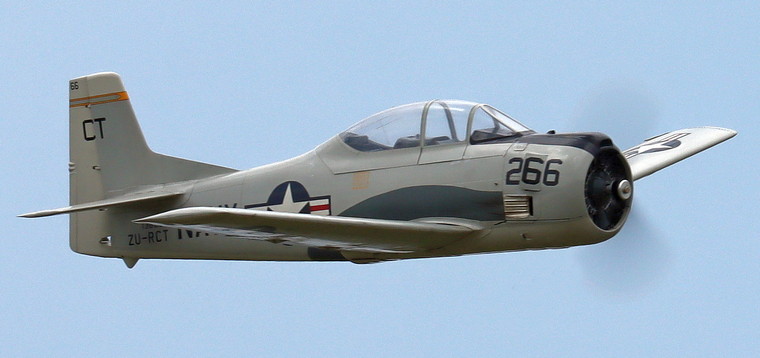
At that stage, the aircraft was still without its full scale detailing. The first flight, however, proved encouraging, with the prototype demonstrating excellent stability.
With the basic design proven, he could proceed with the construction of the fully detailed model while continuing to fly the prototype.
The finished Trojan is a labour of love and a testament to the skill and patience of a master builder.

Constructed using composite materials, the model is powered by an 86cc two-stroke petrol engine driving a 24 x 8-inch, two-blade wooden propeller. The engine turns the propeller at approximately 6,800 rpm, while the model's wheels measure 114 mm in diameter.
Koos flies the aircraft using a 12-channel radio transmitter and receiver. The model is capable of performing the aerobatic manoeuvres of the full-size T-28, making it as impressive in the air as it is on the ground.
Although the Trojan still requires some finishing touches and refinements, it is already a remarkable achievement.
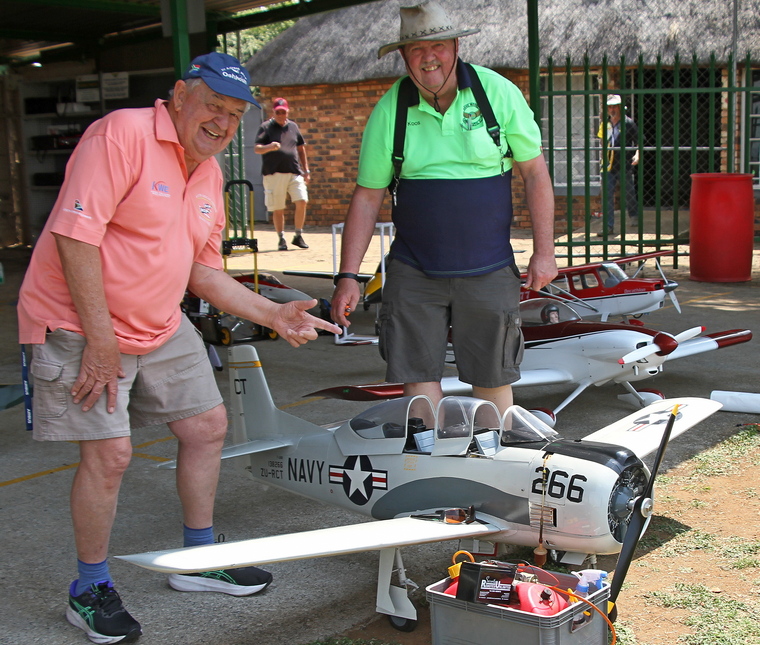
Karl Jensen who started his career flying RC models with Koos
For Koos, however, the work is never quite finished. As any dedicated scale modeller will tell you, there is always another detail to perfect, another refinement to make and another reason to return to the workshop.
And that, perhaps, is what makes this magnificent T-28 Trojan such a fitting tribute to its builder: a masterpiece born from patience, passion and an unwavering commitment to getting every detail right.


|
            |