Midweek Updates 25 November 2026
Compiled by Willie Bodenstein
Google Banner Ad
This Week in Midweek Updates
Aero Club Communique # 22 of 2026.
Sling Aircraft - Join us for the Tedderfield Sling Breakfast Fly-In.
SAAF helicopter crews praised for halting fire at Lohatlha.
Morocco receives another six AH-64 Apaches.
Ghana's Air Force receives new Falcon 6X executive jet.
Airbus A350-1000ULR for Qantas breaks world distance record.
Elixir Aircraft and Turbotech launch the Elixir turbine industrial program.
New exhibition highlights progress towards eliminating aviation fatalities.
This week in history - First Flight of the Fisher P-75 Eagle.
Worldwide Incidents and Accidents.



Aero Club Communique # 22 of 2026
Good day to all our Aero Club members, and to all the general and recreational aviation community. We have news for you about a variety of topics.
Regulatory Developments
In Part 94.06 the requirement was stated that a person operating non-type certified aircraft had to do so under the auspices of a registered Aviation Recreation Organisation. The word “shall” was used in Part 94.06.2 to describe this requirement.
In the 33rd amendment to the S A CAA Regulations the word “shall” was changed to “may”. This has a definite change in the relationship that ordinary recreational pilots using NTCA would have with an ARO. The implication for AROs is significant.
The Aero Club, CAASA with MOGAS and other recreational industry members voiced their opinion that this was an unacceptable situation. We can now report that the 37th amendment to the SACAA regulations contains a proposal to revert to the original wording. This amendment, if approved, will replace the ARO as a body that has some influence over the particular aviation activity of the ARO.
Linked to the change and rectification of Part 94.06.2 is the ongoing rewrite of Part 149. Without the change back to the original wording of Part 94.06.2, the Part 149 activity would have had little value. The Part 149 workgroup has been re-established, and the work continues to change Part 149 to enable this regulation to serve the AROs.
Aero Club Awards and Airweek
At a council meeting it was decided to hold the awards at the yearly Airweek in March next year.
CAASA Awards and Year-End Function
The yearly CAASA awards function was, as always, a very posh occasion. Congratulations CAASA! The CAASA awards were of particular interest to the Aero Club because three of our long-standing members were honoured with an award. Our past-chairman Rob Jonkers, Karl Jensen and Brian Emmenis are the well-deserved recipients of the awards.
Experimental News
The EAA chapters have been busy. EAA 973 held a very successful Sun 'n Fun at the Krugersdorp Airfield. The atmosphere was reminiscent of Oshkosh. Everything was well-organised and catered for the interest of the general aviation enthusiast. Neil Bowden, Laura McDermid and their dedicated team did an amazing job.
EAA 973 is a chapter that is only one year old and is well established. At the AGM held on 14 November Neil, Laura and the rest of the committee were unanimously re-elected to the committee of EAA 973. We wish chapter 973 well for the year ahead.
Another place where there has been EAA activity is in the Western Cape. After many years a group of aviation enthusiasts got together and have revived the old Chapter 592. It has taken months of work and planning and on Saturday the 16th of November this chapter held its inaugural annual general meeting. Etienne Bekker was elected chairman. With his committee, Alan EvansHaines, Guillaume Viljoen and Luzé Crause, we wish them success and good luck for the year ahead.
We will bring news from our 2 other EAA chapters in our next edition
Nothing happens in a vacuum. By this I mean that at the Aero Club things must by necessity be done by a group. I want to thank the Aero Club Council, Exco, our staff and all members for the support and hard work. Without you it won't happen.
Please support the events. Fly safe and enjoy the flying.
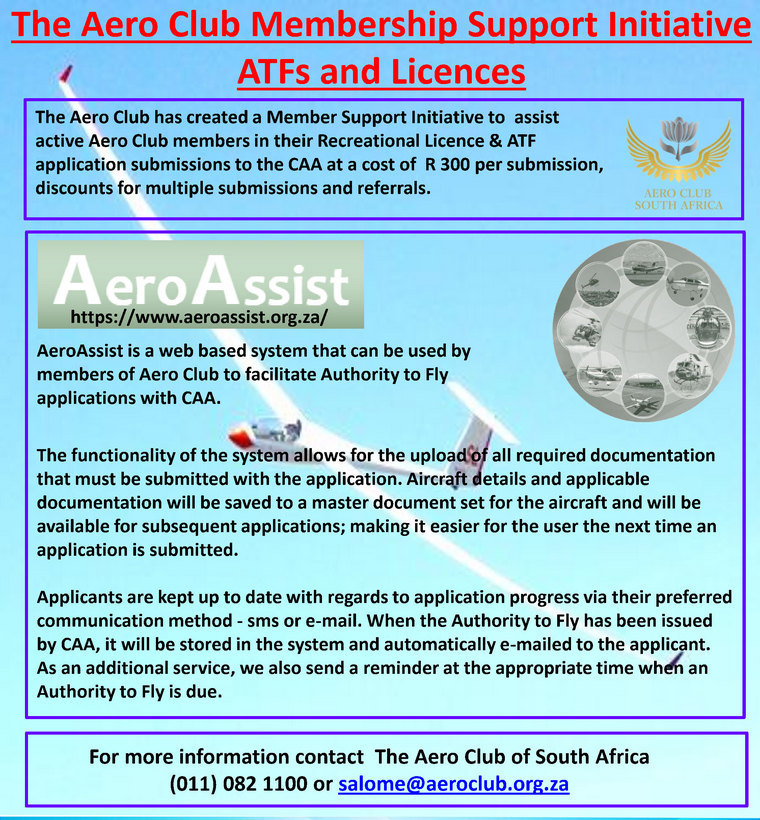
See information below on Aero Club membership renewal, Aero Assist and safety contact detail.
Have a good week,
Regards,
Walter Doubell,
Chairman, Aero club of SA,
17 November 2026
walter@aeroclub.org.za
0798306452
The 2026 Aero Club membership renewal commenced on the 1st of December. Please visit the Aero Club website at https://aeroclub.org.za/membership/ to renew or to register as a new member
Join Us for the Tedderfield Sling Breakfast Fly-In
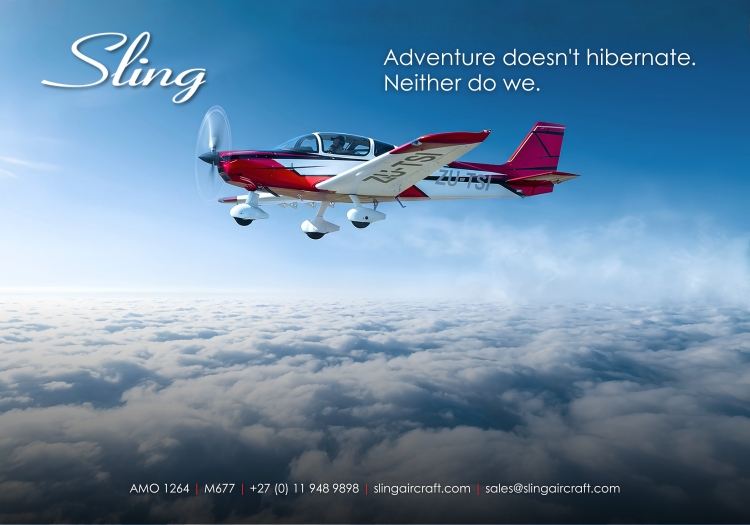
Join us for a festive morning at Tedderfield as we celebrate Sling Into Summer - a fly-in for aviation lovers, future Sling owners, and the whole Sling community. Enjoy a free breakfast and beverages, browse Sling Store merchandise, and soak up the atmosphere with a Sling factory tour and demo flights in the Sling High Wing or Sling TSi.
The event is fur co-pilot friendly, and for those wanting to stay over, camping is available on site with deluxe ablutions, a kitchen, bar, braai area, fire pits, and access to all clubhouse facilities. AVGAS is also available on site at R29.00 per litre.
Demo Flights Available
Sling High Wing and Sling TSi demo flights will be available on the day, so this is the perfect opportunity to experience one firsthand. Please note, this is not about a quick, fun flip for your kids - these demo flights are intended for serious pilots or pilots in training who are genuinely considering the purchase of a Sling. Please remember to book your demo flight in advance via the link below, as this is essential for planning purposes on the day. If you do not book, you will not be permitted to fly.
Factory Tour
From 08h00, guests are invited to enjoy a Sling Tedderfield factory tour for a behind-the-scenes look at where the magic happens.
Sling Store
We'll also have Sling merchandise available for purchase. No cash will be accepted on site but card facilities will be available.
Get all information and don't forget to register your attendance here: https://gbeek.r.bh.d.sendibt3.com/mk/mr/sh/OycXxlTDIzvGSVSjwiHco89x/QGQvm3ldH445
SAAF Helicopter Crews Praised for Halting Fire at Lohatlha
By DefenceWeb www.defenceweb.co.za
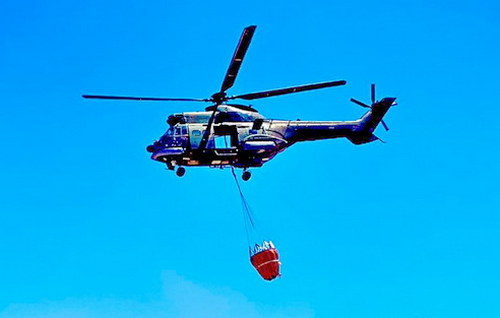
South African Air Force (SAAF) Oryx helicopter crews have been praised for helping prevent a fast-moving veld fire from reaching soldiers' accommodation at the South African Army Combat Training Centre (SA Army CTC) in Lohatlha, Northern Cape, during Exercise Vukuhlome V.
The two helicopters, from 17 Squadron and 22 Squadron, flew firefighting sorties for seven hours and 30 minutes on Thursday 19 November, dropping water on the blaze as it advanced towards tents housing personnel at the training centre.
Between them, the crews completed 102 Bambi bucket drops, carrying 2 000 litres of water each, Major Takalani Thomas Mulaudzi, Operational Communication Officer reported. A Bambi bucket is a collapsible container slung beneath a helicopter, filled with water and released over a fire.
The 17 Squadron Oryx recorded 80 drops, while the 22 Squadron aircraft completed 22. In total, the helicopters delivered 204 000 litres of water to the affected areas.
Although ground firefighting teams were also activated, military officials said the fire was moving rapidly towards the accommodation area and that aerial intervention was decisive.
Lieutenant Colonel Ally Mosehlana, Staff Officer One: Division Staff Three and operational planner for Exercise Vukuhlome V, said the SAAF crews had worked exceptionally hard to protect lives and state property.
“Without the two Oryx, we would be talking disaster by now,” Mosehlana said. “Well done to the South African Air Force.”
The cause of the fire remains unknown.
Major Charles Rossouw, co-pilot of the 17 Squadron Oryx, thanked his crew for their performance during the operation. The aircraft was commanded by Major Jaun-Pierre du Preez, with Flight Sergeant Tshefu Xabisa serving as flight engineer.
The 22 Squadron Oryx was commanded by Major Warren Jobe, co-piloted by Major Dakalo Mulomoni and crewed by Warrant Officer Class 2 Ben Young. Its crew logged one hour and 30 minutes of firefighting operations.
Mulomoni said that, although it was her first visit to the SA Army CTC at Lohatlha, she and her crew had welcomed the opportunity to support the operation.
Colonel Mbekiseni Eshmond Ndlangamadla, Senior Staff Officer Operations: Division Staff Three, extended appreciation to Brigadier General Emmanuel Mokoena, Officer Commanding the Air Force Command Post, and to the Air Force Command Post personnel.
He also thanked Lieutenant Colonel Mario da Silva, Air Component Commander of the SAAF contingent at Lohatlha, and all personnel who supported the response.
“No loss of lives or damage to property was incurred due to the speedy response from the South African Air Force,” Ndlangamadla said. “We say bravo to all aircrew members who worked tirelessly while saving and protecting the resources of the state.”
In a separate incident, a lightning strike sparked a fire at the top of a tree within the buildings of the Combat Training Centre, prompting South African Air Force firefighters to respond swiftly and bring the fire under control. According to Flight Sergeant Kgamenyane Kgame, no personnel were injured, and no damage was incurred during the incident. He stated that had the firefighters not arrived on time, the fire could have spread to the buildings.
The latest incidents evoke memories of the 6 October 2023 veld fire at Lohatlha, which killed six soldiers and injured several others as it swept through the western part of the CTC. The fire had spread from a nearby mine, driven by winds of up to 70 km/h.
The deceased were all non-commissioned officers: Staff Sergeants Abraham Desember Morajane and Sipho Berrington Cele; Corporals Sithembiso Wiseman Ndwalane and Noxolo Faith Ngubane; and Lance Corporals Prince Michael Mthethwa and Londiwe Purity Zulu.
Three soldiers suffered second-degree burns and were evacuated to hospital, while others sustained minor injuries.
The 2023 blaze destroyed or damaged military equipment including 12 Casspirs, 14 logistics vehicles, camping equipment, a container field hospital, water bunkers and fuel. About 1 300 personnel lost shelters and personal belongings.
Exercise Vukuhlome V commenced on 14 September and is scheduled to conclude on 5 December 2026. The name of the exercise is derived from the IsiZulu phrase meaning “arise up and arm yourself.”
The exercise is a culmination of all theoretical training from different corps in the SA Army and other services of the SANDF. It provides an environment for a practical phase and qualifies members of the SANDF for future deployments. Over and above, this exercise certifies the combat readiness of all arms of services of the SANDF, for utilisation by Chief Joint Operations, the SANDF explained.
Furthermore, the exercise plays a crucial role in reinforcing the SANDF's commitment to maintaining high standards of operational readiness, ensuring that the SANDF is well-equipped to respond to any threats that may arise. Senior military leaders and strategists will be closely monitoring the outcomes of this exercise and they will also provide valuable insights into the strengths and areas for improvement.
Morocco Receives another Six AH-64 Apaches
The Royal Moroccan Air Force has taken delivery of another six Boeing AH-64E Apache attack helicopters, bringing the total of delivered aircraft to 19 out of 24 ordered.
By Guy Marin www.defenceweb.co.za
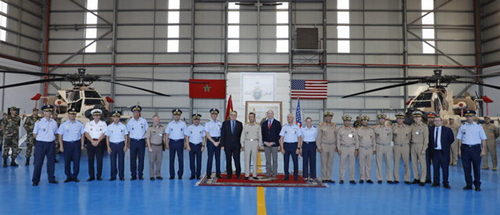
A ribbon-cutting ceremony to mark the receipt of the latest six aircraft was held on 26 October at 1st BAFRA (1ère Base Aérienne des Forces Royales Air) in Sale, next to Rabat-Sale International Airport. Major General Matthew W Brown, commanding general of US Army Southern European Task Force, Africa SETAF-AF), joined senior leaders of the Royal Moroccan Armed Forces for the event.
“This ceremony marks a consequential moment made possible by Morocco's commitment to its own defense capabilities and the broader security of the region,” Brown said. “The aircraft before us is the most capable attack and reconnaissance helicopter in the world.”
The Apache supports the Joint Readiness and Interoperability objectives of the 2026-2036 Defense Cooperation Roadmap, which was signed at the Pentagon in April, SETAF-AF said. Brown said US and Moroccan pilots and land forces will train together on the aircraft during future African Lion exercises.
“Integrating these platforms into the continent's premier joint exercise will directly increase our combined readiness, making our forces stronger, and more capable of operating and fighting alongside each other,” Brown added.
He said Morocco's leadership in regional security is “vital and deeply valued by the United States of America” and that the ribbon cutting “clearly showcases the strength of our alliance.”
“We look forward to the continued growth of this historic alliance as we strive for a future of shared security, stability, and regional peace,” he added.
Morocco was the first country to recognize the US, in 1777, and the two nations share the longest-standing treaty relationship in US history.
The Royal Moroccan Air Force received its first six Apaches, via ship, in March 2025. Deliveries were originally scheduled to take place from 2024, but were delayed.
Boeing began manufacturing Morocco's first AH-64Es in late 2023 after receiving an order for 24 in June 2020 under a $1.3 billion deal. The company is building the new Moroccan Apaches under a contract with the US Army through the US government's Foreign Military Sales process.
In November 2019 Morocco requested the sale of 24 new helicopters and 12 options, along with AGM-114R/L Hellfire missiles, Advanced Precision Kill Weapon System munitions, AIM-92H Stinger missiles, M261 rocket launchers, 70 mm rockets and 30 mm cannon ammunition in a potential deal worth $1.5 billion.
The AH-64E that Morocco has ordered features an improved Modernized Target Acquisition Designation System that provides day, night and all-weather target information, as well as night vision navigation capability. In addition to classifying ground and air targets, Boeing said the Longbow Fire Control Radar has been updated to operate in a maritime environment.
Morocco is one of two African nations (the other being Egypt) that operate the Apache, and the only one that operates the AH-64E. Before Apache deliveries, Morocco's military had no dedicated attack helicopter, instead relying on two dozen Gazelles flown by both Army Aviation and the Royal Moroccan Air Force.
Morocco is also acquiring other military aviation assets from the United States, including 25 F-16C/D Block 72 fighter jets to replace the Mirage F1s it received in the 1970s, the Northrop F-5E/F Tiger IIs it received in the 1980s, and to augment and eventually replace its F-16C/Ds. Lockheed Martin flew Morocco's first F-16 Block 72 at the beginning of October.
The Royal Moroccan Air Force flies 23 F-16C/D Block 50/52 aircraft that it received from 2011 to 2012 (one was lost over Yemen during operations as part of the Saudi-led coalition). The US Defence Security Cooperation Agency in 2019 approved the upgrade of these aircraft to the latest F-16V Block 70/72 standard at a cost of $985.2 million.
Other purchases from the US include 18 M142 High Mobility Artillery Rocket System (HIMARS) launchers, M57 Army Tactical Missile Systems (ATACMS) rounds, 40 AGM-154C Joint Stand Off Weapons (JSOW), and 612 FGM-148F Javelin missiles, among others.
Morocco is aggressively modernising its air force to counter Algiers' formidable arsenal, thanks in part to a large defence budget increase. Its defence budget jumped to $15.3 billion in 2026, a 17.7% hike year-on-year. Complementing acquisitions, Morocco is fostering a burgeoning defence industry through joint ventures, partnerships, and financial incentives.
Recent Air Force acquisitions have included four Gulfstream G550s in an ISR (Intelligence, Surveillance and Reconnaissance) configuration, and various drones including Israeli Heron, Hermes 900, Chinese Wing Loong-2 and Turkish TB2 and Akinci drones.
Morocco has already acquired numerous air defence systems from China, France, Israel, and from the United States, and worked to establish a strong multi-layered network. This network includes a plethora of long range systems (HQ-9B, Barak 8, and Patriot PAC-3), mid-range systems (SPYDER, MICA VL, and Sky Dragon 50) and short range systems (Stinger and Mistral), and is supported by various radar systems such as Ground-Master 400s purchased from France.
Similarly, the Moroccan helicopter force has been growing at a steady pace with10 H225M transport helicopters ordered in November 2025 (the first six arrived in March 2025 and the next six followed in early April this year).

Ghana's Air Force Receives New Falcon 6X Executive Jet
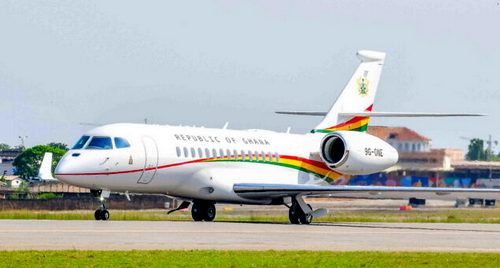
The Ghana Air Force (GAF) has received a new Dassault Falcon 6X long-range jet from France as part of wider efforts to re-equip its armed forces.
The aircraft (9G-ONE) arrived at Accra International Airport on Monday 16 November in what the GAF said was another significant milestone in Government's ongoing defence modernisation programme, aimed at enhancing strategic air mobility, operational efficiency and national development.
Upon arrival, the aircraft was accorded a ceremonial water cannon salute in the presence of the Minister for Defence, Kenneth Gilbert Adjei, the French Ambassador to Ghana, Diarra Dimé Labille, and members of the Military High Command.
“The Falcon 6X is distinguished by its exceptional range, speed, advanced flight-control technology and operational efficiency. With a maximum range of 5 500 nautical miles (approximately 10 186 kilometres), the aircraft is capable of undertaking long-distance international flights without refuelling,” the GAF said.
“Its high operating speed enables faster transit and reduced travel time, while Dassault's advanced Digital Flight Control System enhances aircraft stability, reduces pilot workload and provides additional safety features throughout flight operations. Additionally, the aircraft features a spacious and adaptable cabin designed to support productivity, effective communication and passenger comfort during extended journeys.”
The Falcon 6X was acquired to replace the ageing Falcon 900EX executive jet, which had been experiencing maintenance challenges. Parliament approved the purchase in December 2025 as part of efforts to enhance Ghana's military aviation fleet. Minister of State for Government Communications Felix Kwakye Ofosu said the new aircraft has a longer range than the Falcon 900EX, allowing it to fly without frequent refuelling stops.
The Falcon 6X was acquired for $60 million. Also approved late last year was the acquisition of four helicopters from Airbus Helicopters for €125 million. The first rotorcraft, an H175, arrived in Ghana on 5 March.
Ghana has ordered two H175Ms, one ACH175, and one ACH160 from Airbus Helicopters for transport, search and rescue, disaster relief, and other duties. The H175M is a military configured airframe to be used for missions such as personnel and cargo transport and civil support, while the ACH160 and ACH175 are corporate configured helicopters likely acquired for VIP duties. One more helicopter is expected to be delivered later this year followed by another two helicopters in 2027.

Airbus A350-1000ULR for Qantas Breaks World Distance Record
The Airbus A350-1000ULR (Ultra-Long Range) has officially broken the Guinness World Record for the longest flight by distance by a commercial airliner. The record was based on aircraft data independently validated by the International Aeronautical Federation and flightradar24.
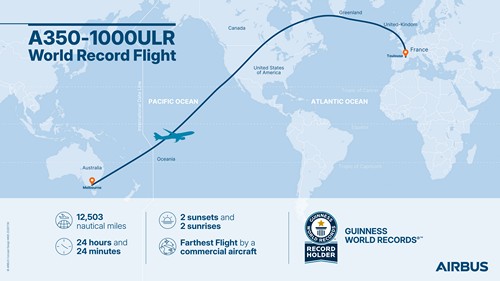
The Airbus-operated flight, with call-sign AIB35LR, departed Melbourne, Australia at 17.27 local time (07.27 UTC) on Monday 27 July and landed in Toulouse, France at 09.51 am local time (07.51 UTC) on Tuesday 28 July. The flight covered a distance of 12,503 nautical miles (equivalent to 23,155 kilometres), with a flight time of 24 hours and 24 minutes.
The mission was undertaken as part of the flight test campaign for the A350-1000ULR, which is being developed for Qantas Airways under Project Sunrise. This included a requirement for Airbus to operate one sector with a block time of 23 hours (from push-back at departure to chocks-on at arrival) to simulate the very longest commercial operations that will be possible with the aircraft.
After take-off from Melbourne the aircraft flew over Sydney before heading out over the Pacific on a north-easterly routing towards Los Angeles, crossing the international date line en route. It then flew across the North American continent and over the Atlantic before heading south towards the UK, flying over London and on to Toulouse. As the aircraft crossed three continents and two oceans, the crew witnessed two sunsets and two sunrises.
A total of 13 people were on board the aircraft. These included a flight crew of three Airbus flight test pilots, two pilots from Qantas and five Airbus flight test engineers. Two Airbus design engineers were also on board, plus a representative of the International Aeronautical Federation.
"This achievement reflects the pioneering and innovative spirit that is part of our DNA at Airbus. In responding to the challenge laid down by Qantas, our teams came together to extend the range of the A350-1000 in an efficient and economically viable way to undertake the world's longest ever commercial flights,” said Lars Wagner, Chief Executive Officer Commercial Aircraft at Airbus. “Flying 12,503 nautical miles non-stop, we have fully proven the aircraft's capability to fulfill its mission. And the world record was the icing on the cake!”
“Huge congratulations to all the teams at Airbus who have made this project a reality. And thank you to Qantas for an incredible partnership that has seen us push boundaries together, to Rolls-Royce for its full support and to all our partners who have contributed to this exciting moment in aviation history. Today we can say that the A350 truly is the undisputed Long Range Leader!” Lars added.
The A350-1000ULR will enable Qantas Airways to operate non-stop flights between Sydney and London and New York for the first time ever - a distance of almost 10,000 nautical miles, with flight times of up to 22 hours. This is made possible primarily by the integration into the aircraft structure of an additional rear centre tank (RCT), enhancing further the aircraft performance and increasing the range of the aircraft by 1,000 nautical miles.
The A350-1000ULR is the fourth passenger variant of the best-selling A350 Family, joining the A350-900, A350-900ULR and the A350-1000. Together, the aircraft have set new standards in long haul air travel, with a step-change reduction in fuel consumption and carbon emissions, and new levels of comfort. The passenger line-up will soon be joined by the all-new A350F freighter, which took to the skies for the first time on 29 September for a nine month flight test programme.
At the end of October 2026, the A350 Family had won 1,628 orders from 70 customers, with more than 740 aircraft already flying with 42 operators, primarily on long haul services across the globe.
Qantas has ordered 12 A350-1000ULRs under Project Sunrise. The first aircraft is scheduled for delivery next April with entry into service on the Sydney-London route later in the year. In addition, the carrier also has 12 standard A350-1000s on order for future operation across its long haul network.
Elixir Aircraft and Turbotech Launch the Elixir Turbine Industrial Program
Following the first engine start in February 2025 and its maiden flight in June of the same year, the Elixir Turbine demonstrator successfully completed its initial flight test campaign.
Building on these results, Elixir Aircraft and Turbotech announced the signing of a MoU, marking the launch of the Elixir Turbine industrial program.
The agreement covers aircraft integration and development activities, as well as the launch of the EASA and FAA certification programs, with entry into service targeted by 2030.
Powered by Turbotech's TP-R90 turbine engine-already entering industrial-scale production and commercially available in both Europe and the United States-the Elixir Turbine benefits from a mature, multi-fuel propulsion system with an exceptionally long Time Between Overhauls (TBO).
Combined with Elixir Aircraft's Carbon OneShot airframe, this powerplant paves the way for an aircraft delivering enhanced performance, simplified operation through a single-lever power control inspired by commercial aircraft, exceptionally low operating costs, and a reduced environmental footprint thanks to compatibility with all aviation fuels, including Sustainable Aviation Fuel (SAF).
Complementing the new Elixir product lineup unveiled at EAA AirVenture Oshkosh, the Elixir Turbine is designed to meet the evolving needs of flight training organizations by delivering outstanding fleet availability.
“After a year of highly encouraging flight testing, we are now reaching a major milestone. The Elixir Turbine will complement our new aircraft lineup and provide professional operators with a solution combining ease of operation, exceptionally low operating costs, maximum aircraft availability, and compatibility with Sustainable Aviation Fuel,” said Arthur Léopold-Léger, President and Co-founder of Elixir Aircraft.
“The signing of this agreement formalizes a technical collaboration that began several years ago and confirms the maturity of our technology. Thanks to the ramp-up of our production capabilities and the experience gained with our first turbine engines in Europe and the United States, we are ready to support Elixir Aircraft in bringing a new benchmark for professional general aviation” said Damien Fauvet, President and Co-founder of Turbotech.
ICAO - New Exhibition Highlights Progress Towards Eliminating Aviation Fatalities
The International Civil Aviation Organization (ICAO) has launched a new safety exhibition at the Museum in its Montréal Headquarters. This initiative coincides with the first year of implementation of ICAO's long-term strategic plan, which envisions air transport for all by 2050, with zero fatalities and net-zero carbon emissions.
Sponsored by Airbus, the year-long exhibition explores the pathways towards the realization of this vision. It highlights the foundations of aviation safety that have been developed over the past eighty years and presents how further progress will be achieved. Visitors will explore interactive displays and real-world examples that show how global cooperation, technology, and effective safety standards have created safe skies.
“The world's safest form of transportation is a testament to decades of international cooperation, harmonized standards, and a shared commitment to safety,” remarked ICAO Council President Toshiyuki Onuma at the dedication ceremony last night, with ICAO Secretary General Juan Carlos Salazar adding that “Zero fatalities is more than an aspiration-it is the shared commitment of every person across the global aviation community to making aviation safer, every day.”
"At Airbus, safety is our number one priority. We're humbled that millions of people fly in our aircraft every year, placing their trust in our Company and in the air transport system as a whole. We are therefore delighted to be sponsors of ICAO's Safety Promotion Exhibition, a story of innovation, cooperation and the vigilance of countless aviation professionals” CEO Guillaume Faury.
Guided tours can now be booked through the ICAO website. The general public will also be able to visit the Museum without a reservation on Thursdays and Fridays as of 23 November.


17 November 1943
First Flight of the Fisher P-75 Eagle
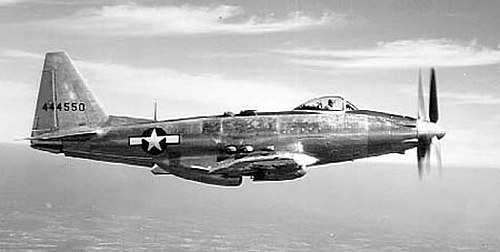
The Fisher P-75 Eagle (often referred to as the XP-75 Eagle) was an experimental World War II fighter aircraft designed by the Fisher Body Division of General Motors for the United States Army Air Forces.
Designed as a single-seat fighter and interceptor it was later shifted to a long-range escort. It had its first f light on 17 November 1943. Fourteen, 8 XP-75 prototypes and 6 P-75A production models, were eventually build.
The order was canveeled on6 Oct 1944 as the USAF by then relied on proven escorts like the P-51 Mustang and P-47 Thunderbolt.


Congo (Democratic Republic), Kalonge, South Kivu: A military Cessna 208B Grand Caravan (or an Cessna AC-208B Combat Caravan?) operated by or on behalf of the Armed Forces of the Democratic Republic of Congo (FARDC) crashed near Kalonge. Two people on board were killed, while two others, the South African pilot and a Ugandan national, survived.
UK, Loch Leven, near Kinross: An SZD-54-2 Perkoz crashed during a training flight under unknown circumstances into Loch Leven, near Kinross. Both occupants perished. Published OGN data indicate a winch launch to about 1,200ft followed by a seemingly normal flight before the aircraft descended to about 800ft and entered a period of increasing turn-rate, high sink and decreasing ground speed.
MEXICO, near Monterrey-Aeropuerto Del Norte (NTR/MMAN): A Piper PA-46-310P Malibu, XB-MKC, overshot runway 11 during takeoff from Monterrey-Aeropuerto Del Norte (NTR/MMAN). The aircraft went through the perimeter fence crossed the Monterrey-Nuevo Laredo highway and burst into flames. All six on board evacuated the aircraft. MMAN runway 11 has a Takeoff Distance Available (TORA) of 1539 meters. The distance between the end of the paved surface and the perimeter fence is about 13 metres.

Google Banner Ad
|
               |