Developed to a 1943 requirement of the United States Army Air Forces (USAAF) for a reconnaissance bomber that harnessed newly-developed jet propulsion North American Aviation, Convair, Boeing and the Glenn L. Martin Company submitted proposals for the new long-range jet bomber.
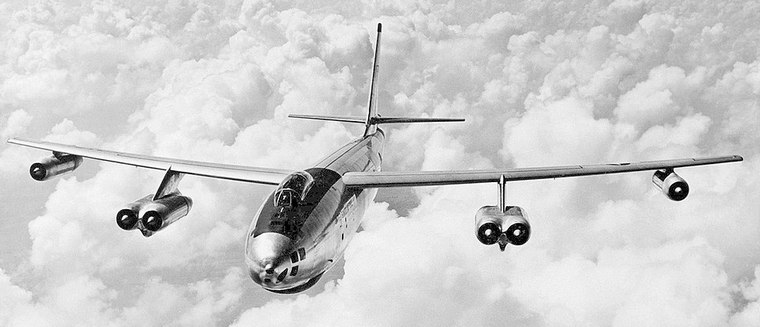
The initial concept evolved into a formal request-for-proposal to design a new bomber with a maximum speed of 550 mph (480 kn; 890 km/h), a cruise speed of 450 mph (390 kn; 720 km/h), a range of 3,500 mi (3,000 nmi; 5,600 km), and a service ceiling of 45,000 ft (13,700 m). The XB-47 carried a crew of three in a pressurized forward compartment: a pilot and copilot, in tandem, in a long fighter-style bubble canopy, and a navigator/bombardier in a compartment in the nose. The copilot doubled as tail gunner (using a remotely controlled, radar-directed tail gun), and the navigator as bombardier.[16] The bubble canopy, which provided a high level of visibility to the pilots,
The USAAF ordered two XB-47 prototypes from Boeing and on 17 December 1947, the first prototype performed its maiden flight. During an early test flight, the canopy of a XB-47 came off at high speed, killing pilot Scott Osler; the aircraft was safely landed by the copilot. The accident resulted in a canopy redesign and the hiring of pilot Tex Johnston as chief test pilot. In February 1949, Russ Schleeh and Joe Howell broke all coast-to-coast speed records flying from Moses Lake AFB to Andrews AFB, averaging 607.8 miles per hour (528.2 kn; 978.2 km/h.
A formal contract for 10 Boeing B-47A bombers was signed on 3 September 1948 and the first B-47 tool to the sky on 17 December 1947. More orders soon followed and 2,402 were eventually built. The last B-47E was retired in 1969 while some EB-47E test bed versions saw service until 1977.
The B-47 entered operational service with the United States Air Force's Strategic Air Command (SAC) during the 1950's. Driven by the tensions of the Cold War it became the mainstay of the USA's bomber strength serving until 1965 when it was largely replaced by Boeing's own B-52 Stratofortress.
During the late 1940s, the bomber was hailed as the fastest of its class in the world. The first prototypes were fitted with General Electric J35 turbojets, the production version of the TG-180, with 3,970 lbf (17.7 kN) of thrust.
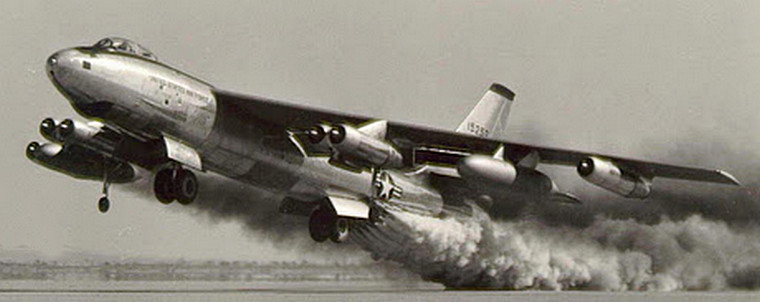
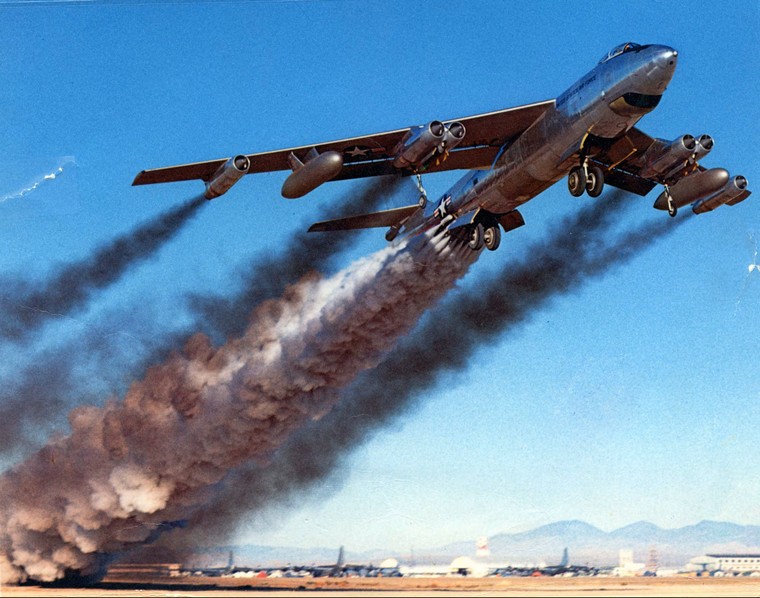
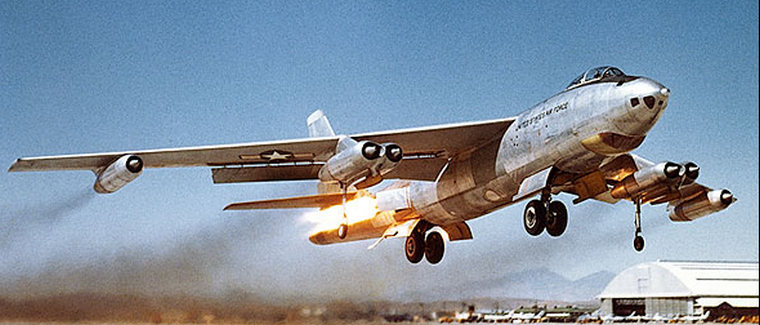
Early jet engines did not develop good thrust at low speeds, so to assist take off when heavily loaded, the B-47 had provisions for fitting solid-fuel rocket-assisted takeoff (RATO) rockets, each generating roughly 1,000 lbf (4.4 kN) of static thrust.
The USAF Strategic Air Command operated multiple B-47 models from 1951 through 1965. Upon entry to service, its performance was almost equel to that of contemporary fighters allowing it to set setting multiple records with ease. It handled well in flight, the controls having a fighter-like light touch.
The large bubble canopy enhanced the flying crew's vision and gave a fighter-like feel, but also caused internal temperature variations for the crew.
B-47's were also adapted to perform a number of other roles and functions, including photographic reconnaissance, electronic intelligence, and weather reconnaissance. While never seeing combat as a bomber, reconnaissance RB-47s would occasionally come under fire near or within Soviet air space.
By 1956, the USAF had 28 wings of B-47 bombers and five wings of RB-47 reconnaissance aircraft. The B-47 was the first line of America's strategic nuclear deterrent, often operating from forward bases in the UK, Morocco, Spain, Alaska, Greenland and Guam. B-47s were often set up on "one-third" alert, with a third of operational aircraft available sitting on hardstands or an alert ramp adjacent to the runway, loaded with fuel and nuclear weapons, crews on standby, ready to attack the USSR at short notice.
The B-47 was the backbone of SAC into 1959, when the B-52 began to assume nuclear alert duties and the number of B-47 bomber wings started to be reduced.
The only B-47s to see anything close to combat were the aerial reconnaissance variants. At least five aircraft were fired upon and three were shot down. The RB-47s returned fire with their tail turrets, although it is uncertain if they scored any kills; these were the only shots fired in anger by any B-47.
On 8 May 1954, after a top secret reconnaissance mission near the Kola Peninsula, a 4th Air Division / 91st Strategic Reconnaissance Wing RB-47E, flown by then-Capt (later Col) Harold "Hal" Austin, overflew the Soviet Union at high altitude, out of reach of MiG-15s. Unknown to USAF intelligence, MiG-17s capable of intercepting it had been stationed nearby. The RB-47E was chased by several MiG-17s, firing upon it with their guns over Soviet and Finnish airspace. While taking damage, the RB-47E escaped over Sweden to its home base at RAF Fairford, Gloucestershire. Its top speed and combat radius superiority to the fighter jets were decisive factors. The mission marked the first time a jet aircraft equipped with modern aerial photography equipment, K-17 and K-38 cameras, was used for USAF reconnaissance over the Soviet Union. The incident was kept secret by all parties.
B-47 production ceased in 1957. The final recorded flight of a B-47 was on 17 June 1986, when a B-47E was restored to flightworthy condition for a one-time ferry flight. This aircraft was flown from Naval Air Weapons Station China Lake, California, to Castle Air Force Base, California, for static display at the Castle Air Museum, where it presently resides.