High-Climb Interceptor - Lofty Ideas: The Fisher P-75
By Willie Bodenstein
22.03.2026
In 1942, with World War II raging across Europe, Germany intensified its aerial assault on the British Isles. The aim was clear; cripple Britain's defences and pave the way for a possible invasion.
It soon became evident that this would be a war of attrition, where victory would depend on destroying the enemy's capacity to sustain its war machine. Strategic bombing of industrial centres became the primary tactic, ushering in the era of large-scale bomber operations and with it, the urgent need for high-performance interceptor aircraft.
While proven fighters such as the North American P-51 Mustang and Republic P-47 Thunderbolt were already in service, early variants lacked the range and climb performance required to effectively escort bombers deep into enemy territory. The United States Army Air Forces (USAAF) therefore sought a new type of fighter one capable of rapid ascent and long-range escort duties.
In September 1942, the Fisher Body Division of General Motors responded to this requirement with an ambitious design centred around the powerful Allison V-3420, the most potent liquid-cooled engine then available. Thus began the development of what was intended to be the ultimate high-climb interceptor-the P-75 Eagle. The programme held great promise, with an initial production expectation of 2,500 aircraft.
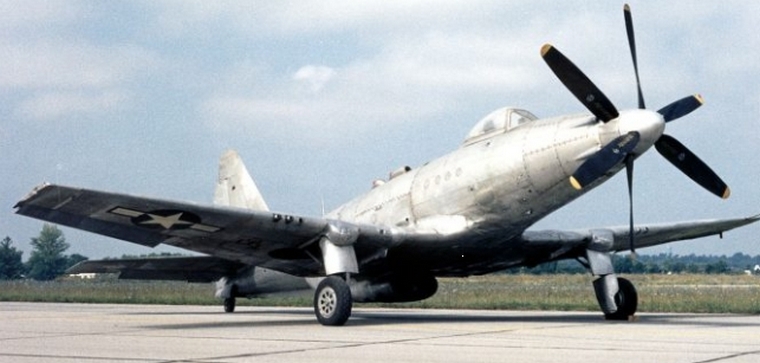
To accelerate development and reduce costs, the P-75 incorporated components from existing aircraft. Its design drew on the outer wing panels of the Curtiss P-40 Warhawk, the tail assembly of the Douglas A-24, and the landing gear of the Vought F4U Corsair. The overall configuration resembled that of the Bell P-39 Airacobra, with a mid-mounted engine driving contra-rotating propellers via extension shafts.
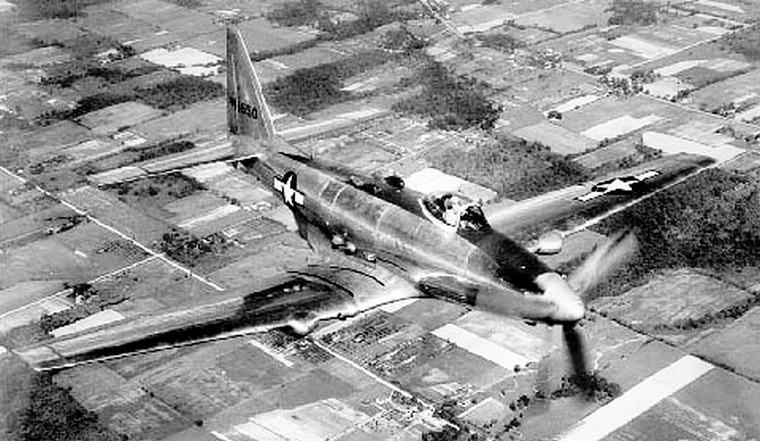
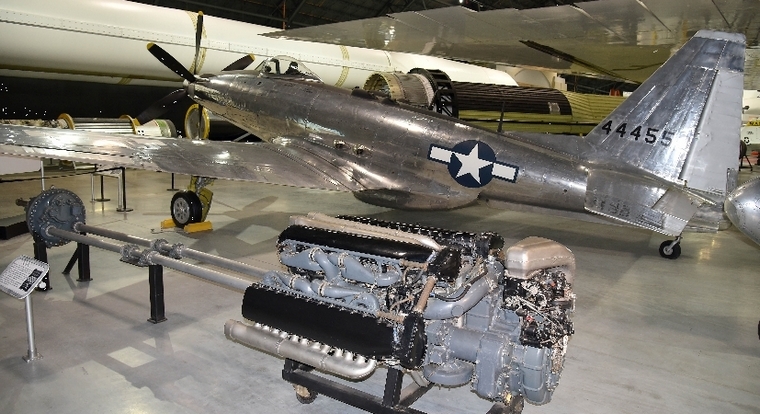
Powered by a 24-cylinder Allison V-3420-19 engine producing 2,600 horsepower, the XP-75 took to the skies for the first time on 17 November 1943. However, the flight test programme quickly revealed a host of serious issues. These included engine unreliability, poor spin recovery characteristics, incorrect centre-of-mass calculations, and heavy aileron forces at high speeds.
By September 1944, the improved P-75A variant entered testing with several refinements, including a redesigned tail unit, a new bubble canopy, and the upgraded V-3420-23 engine, which addressed many of the earlier shortcomings.
But by then, the strategic landscape had changed. The USAAF already had highly capable long-range escort fighters in the Mustang and Thunderbolt, rendering the P-75 increasingly redundant. Consequently, the ambitious order for 2,500 aircraft was cancelled.
In the end, only two XP-75 prototypes and six P-75A production aircraft were built. Tragically, three of the P-75As were lost in accidents during testing, claiming the lives of two pilots-further highlighting the aircraft's troubled development.
Today, just one Fisher P-75 Eagle survives. It is preserved in the Experimental Aircraft Gallery of the National Museum of the United States Air Force, serving as a reminder of a bold but ultimately unsuccessful attempt to push the boundaries of fighter design during one of history's most demanding periods.
The P-75 stands as a classic example of wartime urgency driving innovation-where ambitious ideas, though not always successful, played a vital role in shaping the evolution of military aviation.