This week in Midweek Updates
Super Guppy returning to Oshkosh.
Historic Aircraft from National WASP Museum join Warbirds Lineup for AirVenture 2026.
Airlink touches down in Zanzibar.
World's longest-range aircraft, the Airbus A350-1000ULR takes to the skies.
electra completes first urban flight of hybrid-electric ultra-short aircraft in downtown Charleston.
Whisper Aero and Tennessee Tech partner on UltraQuiet™ electric glider project.
Whisper Aero announces JetFoil™ enabled collaborative logistics aircraft for the US Department of Defence.
Airbus introduces un-crewed version of the H145, the U145.
A Brief history of the Douglas-Davis Cloudster
Worldwide Incidents and Accidents
Bonus video - Bi Wing legend the Pitts Special
Super Guppy Returning to Oshkosh
NASA's Super Guppy, one of the most popular aircraft to appear on Boeing Plaza in recent years, will be back at EAA AirVenture Oshkosh in 2026 and will undoubtedly be a favourite photo op once again.
The Super Guppy made its first appearance at Oshkosh in 2000 and last appeared at the fly-in in 2023. Designed in the 1960s by Aero Spacelines Industries (ASI) and based on the Boeing C-97J Stratocruiser, the Super Guppy is one of the oddest-looking airplanes flying today.
The aircraft is designed to carry oversized cargo, leading to extreme dimensions for the fuselage. The cargo hold is 111 feet, 6 inches long and has a maximum height of 25 feet, 6 inches and a 25-foot diameter. Powered by four Allison T56 turboprop engines, the airplane has a maximum takeoff weight of 170,000 pounds and can carry a 48,000-pound payload, with a cruise speed of 290 mph at 25,000 feet. It has a hinged nose that opens 110 degrees, similar to a refrigerator door, allowing for frontal cargo loading. Cargo is transported on pallets with a system of rails within the cargo hold.
The Super Guppy is expected to be at AirVenture throughout the week, with the majority of that time scheduled to be on Boeing Plaza.
Historic Aircraft from National WASP Museum Join Warbirds Line-up for AirVenture 2026
Two historic World War II-era aircraft from the National WASP WWII Museum in Sweetwater, Texas, will highlight the importance of women pilots during that period when the airplanes travel to Wittman Regional Airport for EAA AirVenture Oshkosh. The 73rd edition of EAA's fly-in convention is July 20-26.
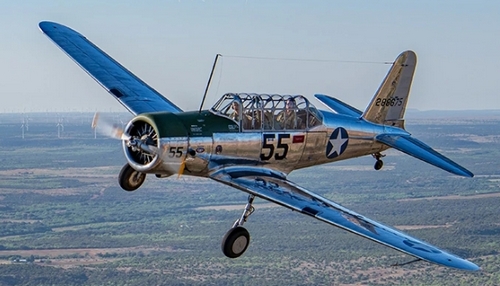
Representing the museum at Oshkosh will be two historic training aircraft that played a critical role in the wartime training pipeline at Avenger Field. The museum's 1943 Vultee BT-13 Valiant and North American AT-6 Texan serve as flying reminders of the progression from basic flight instruction to advanced military aviation training completed by the WASP during World War II. Together these aircraft tell the story of how women pilots were trained to support one of the largest military aviation operations in history.
“As the National WASP WWII Museum prepares for its appearance at EAA AirVenture Oshkosh, the museum will proudly represent the legacy of the Women Airforce Service Pilots at one of the largest aviation gatherings in the world,” said Rachael McClain, the museum's executive director. “Located at historic Avenger Field in Sweetwater, the museum is dedicated to honouring the Women Airforce Service Pilots and preserving the story of the first American women to fly United States military aircraft. Since opening its doors more than 20 years ago, the museum has become a national destination for aviation history, welcoming thousands of visitors and students each year to experience the stories of courage, determination, and service that changed the role of women in aviation forever.”
The Vultee BT-13 Valiant formed the foundation of military flight training for thousands of American aviators during World War II. Officially named the Vultee Valiant, the BT-13 was humorously nicknamed the “Vultee Vibrator” by pilots because of its powerful engine vibration, and it introduced trainees to heavier aircraft with greater complexity and performance demands. The museum's silver BT-13, restored and donated in honor of WASP pilot Betty Wall Strohfus, appears in the same markings seen at Avenger Field during the war. This aircraft represents the stage of training where WASP trainees refined the precision flying skills needed before moving on to advanced trainers and operational aircraft.
The North American AT-6 Texan represented the final stage of advanced single-engine training for many WASP trainees. In the AT-6, pilots mastered aerobatics, formation flying, cross-country navigation, and instrument flight. The aircraft demanded discipline, precision, and confidence from every pilot who flew it. The museum's AT-6D was built in Grand Prairie, Texas, and served at Luke Field, Arizona, one of the Army Air Forces' largest advanced training bases during World War II. Of all the aircraft flown by the WASP, many later remembered the AT-6 as their favorite because of its speed, maneuverability, and direct connection to combat aircraft operations.
The training completed in aircraft such as the BT-13 and AT-6 prepared WASP pilots for vital wartime missions that directly supported America's combat operations overseas. WASP flew every aircraft in the Army Air Forces inventory, including the twin-engine B-25 Mitchell bomber and the four-engine B-17 Flying Fortress. They ferried newly built aircraft from factories to military bases, transported cargo and personnel, towed aerial gunnery targets, and conducted test flights on repaired aircraft. Their service freed male pilots for overseas combat assignments during a critical period of the war.
Among the most remarkable chapters in WASP history was their connection to the B-29 Superfortress program. During the war, the B-29 developed a reputation as a dangerous and difficult aircraft to fly, causing hesitation among many male pilots assigned to transition training. In response, Colonel Paul Tibbets trained two WASP pilots, Dora Dougherty and Dorothea Moorman, to help demonstrate the capabilities and safety of the new B-29 Superfortress. At a time when the aircraft had developed a reputation for mechanical problems and dangerous handling characteristics, the WASP flew the B-29 to demonstrate the bomber to skeptical male pilots and commanders. Their professionalism, precision, and confidence in the aircraft helped restore trust in the B-29 program and supported the successful introduction of one of the most important bombers of World War II. The B-29 would later play a decisive role in the Pacific theater and in bringing the war to an end.
“As EAA AirVenture 2026 celebrates more than a century of American aviation innovation during our nation's 250th anniversary, it is fitting that the WASP are recognized for their contributions beside the B-29 and other historic aircraft at the largest annual warbirds gathering in the world,” said Rick Larsen, EAA's vice president of communities and member programs, who coordinates AirVenture features and attractions. “The appearance of these aircraft at Oshkosh highlights the museum's ongoing mission to preserve living history through aviation.”
AirVenture guests will have the opportunity to experience the sights and sounds of the same aircraft that trained the pioneering women pilots of Avenger Field. Through aircraft preservation, interactive exhibits, educational programming, and outreach initiatives, the National WASP WWII Museum continues to inspire future generations with the courage, leadership, and determination demonstrated by the WASP during World War II.
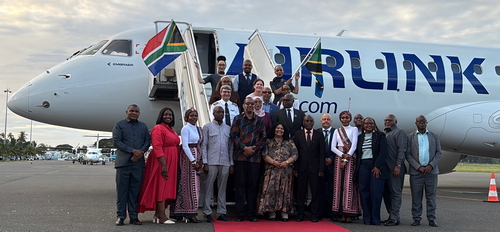
Airlink Touches Down in Zanzibar
Southern Africa's premier airline, touched down in Zanzibar today inaugurating its new year-round, twice-a-week, return service from Johannesburg.
The legendary Tanzanian island in the Indian Ocean is famous for its history, culture, spices, beaches, forest and marine life and resorts. These have made Zanzibar an increasingly popular destination for tourists from around the world, including South Africa. So much so that Airlink will add a third weekly return flight on the route from 15 December 2026 to 13 January 2027 for the peak summer holiday season. These are in addition to an entirely new non-stop service between Cape Town and Zanzibar, launching on 03 October 2026.
“Besides becoming a tourist bucket-list destination, Zanzibar's flourishing economy, which includes its traditional spice trade but also manufacturing, fishing, marine tourism and offshore oil and gas exploration, is an increasingly powerful magnet for investment and trade, which Airlink is well-placed to support,” said de Villiers Engelbrecht, Airlink CEO.
Zanzibar's proximity to Johannesburg, Airlink's main hub, puts the island within reach of customers based in the greater Gauteng area. The convenient timing of the flights allows for easy connections with Airlink's network of 48 destinations in 15 countries across South Africa and the SADC region. Similarly, they provide easy connections for customers travelling between Zanzibar and the rest of the world through Airlink's inter-continental partner airline network.
The adoption of an efficient, new online electronic visa application system and the alternative option of obtaining visas on arrival, are also contributing to Zanzibar's popularity.
Zanzibar is also the first international destination for Airlink's brand new, state-of-the-art Embraer E195-E2 flagship passenger jets. These modern, fuel-efficient aircraft accommodate up to 136 passengers in comfortable seats with generous leg-room and a choice of either aisle or window seats - Airlink aircraft do not have middle seats.
Onboard, customers receive complimentary meals and refreshments. Airlink customers also benefit from a free 15kg sporting equipment allowance in addition to 20kg free checked luggage for discounted economy class tickets, and 30kg checked luggage for full-fare economy travellers.
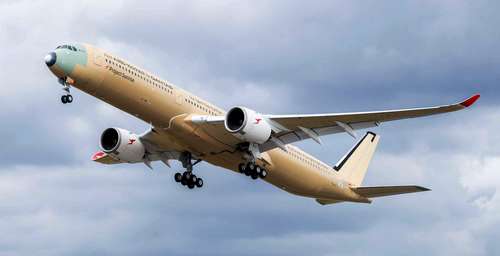
World's longest-range aircraft, the Airbus A350-1000ULR takes to the skies
The A350-1000ULR (MSN 707), the first of 12 aircraft ordered by Qantas has completed its first flight in Toulouse, France. The aircraft, fitted with special flight test instrumentation, flew for three hours 43 minutes reaching an altitude of slightly above 41,000 feet. The aircraft was flown by a dedicated Airbus flight test crew.
The A350-1000ULR is being developed for Qantas Airways to enable non-stop flights between Sydney and London for the first time ever - a distance of almost 10,000 nautical miles, with flight times of up to 22 hours. This is made possible primarily by the integration into the aircraft structure of an additional rear centre tank (RCT), enhancing further the aircraft performance and increasing the range of the aircraft by 1,000 nautical miles.
During the first flight the crew carried out general aircraft performance checks and tested the new fuel system architecture. This marks the start of a two month flight test campaign to certify the modifications. In addition, a new galley air cooling system will also be certified, which features lighter and more efficient refrigeration units for very long flights. The ventilation and temperature control of the cabin will also be thoroughly tested.
Following the flight test campaign, MSN 707 will be retrofitted to Qantas' commercial specifications.
The second A350-1000ULR to be produced for Qantas and the first scheduled to be delivered to the airline in April 2027, is now at an advanced stage of final assembly and ready to roll out of the paint shop in the coming days. This will be followed by completion of the premium four class cabin layout and engine installation.
The A350-1000ULR is the fourth passenger variant of the best-selling A350 Family, joining the A350-900, A350-900ULR and the A350-1000. Together, the aircraft have set new standards in long haul air travel, with a step-change reduction in fuel consumption and carbon emissions, and new levels of passenger comfort.
The passenger line-up will soon be joined by the all-new A350F freighter, also currently under development at Airbus, with first flight planned later this year.
At the end of April 2026, the A350 Family had won 1,579 orders from 68 customers, with over 700 aircraft flying with 41 operators, primarily on long haul services across the globe.
Qantas has ordered 12 A350-1000ULRs under Project Sunrise, designed to overcome one of the last frontiers in non-stop travel from Australia. In addition the carrier also has 12 standard A350-1000s on order for future operation across its long haul network.
Electra Completes First Urban Flight of Hybrid-Electric Ultra Short Aircraft in Downtown Charleston
Electra, the global leader in ultra-short hybrid-electric aviation, announced the successful completion of the first urban demonstration of its Ultra Short airplane at the Columbus Street Terminal, offering a real-world look at how regional air travel can move beyond airports to become faster, simpler, and far more accessible.
Hosted by SC Ports during the CAPA Airline Leader Summit Americas, the flight highlights how Electra's hybrid-electric propulsion and blown-lift technology enable take-offs and landings in 150 feet or less, opening up entirely new places for air services to operate, called Ultra Short Access Points, like parking lots, rooftops, fields, and barges. While Electra's EL2 technology demonstrator completed the flight, Electra's flagship EL9 nine-passenger aircraft will ultimately serve as a regional shuttle to fill the regional mobility gap.
This new approach is called Direct Aviation-a model that targets the more than 35 million daily trips that fall between driving and flying on routes where travellers can save hours by going direct without the usual friction of commercial air travel. It's designed for a wide range of travellers, from business professionals looking to save hours in a day, to families trying to make the most of a weekend getaway, or anyone who wants to stay connected to loved ones without turning a short trip into an all-day journey.
The Charleston demonstration builds on Electra's recent release of the first-ever Direct Aviation Market Outlook, a nationwide analysis of U.S. travel patterns that quantifies the scale of regional mobility demand and outlines how Direct Aviation will reshape it. The report uncovers a massive opportunity: tens of millions of trips happen every day at distances that are too long to drive efficiently but poorly served by traditional aviation. These are exactly the kinds of trips where Direct Aviation will cut hours off door-to-door travel times.
Among routes with at least 1,000 travelers per day, the analysis identifies: 1,851 routes with more than one hour of potential time savings, 540 routes with more than two hours of potential time savings and 227 routes with more than three hours of potential time savings
Earlier this year, Electra was selected as an inaugural participant in the U.S. Department of Transportation's Advanced Air Mobility pilot operations program (the “eIPP”), which is accelerating the safe deployment of Advanced Air Mobility aircraft. As part of that effort, Electra is working with public and private partners on groundbreaking demonstrations including connecting urban and regional destinations in Florida and linking metropolitan centers in New York, New Jersey, and Pennsylvania. The company also supported the submission from the State of Louisiana.
Whisper Aero and Tennessee Tech Partner on UltraQuiet™ Electric Glider Project
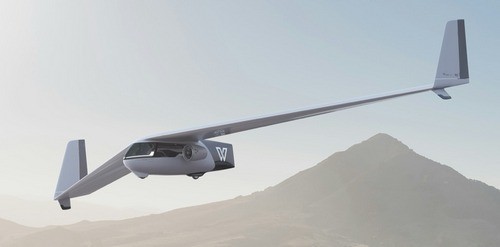
Whisper Aero and Tennessee Tech have been awarded a $500,000 TNGO (Transportation Network Growth Opportunity) award by TNECD (Tennessee Department of Economic and Community Development) to advance the development and testing of the Whisper Ultralight, a single seat powered glider capable of UltraQuiet™ flights.
The Whisper Ultralight is a retrofit of an Aériane Swift3 glider with two of Whisper's eQ250 propulsors, capable of 80 lbf each. The Whisper Ultralight has a wingspan of over 40 ft with a maximum L/D of 35:1 and can be stressed to a design loading of +6/-4g. The zero control surface deflection trim speed is now 45 mph, equal to the best glide speed. The retrofitted Swift3 glider is designed for a low speed, low power cruise speed of 42-55 knots so that cruise power required is only 6.5 hp. Power-off glides from a few hundred feet showed a low sink rate. The powered version has a climb rate of 1,250 ft/min for self-launching capability. Whisper is teaming with Steve Morris, designer of the Aériane Swift3 glider, and Brian Porter, a championship SWIFT pilot and test pilot for this program, to make this a reality.
Battery modules from Electric Power Systems (EPS) will power the glider for demonstration flights. With EPS EPiC 1.0 power batteries, the powered-on flight range is 109 miles. Whisper previously demonstrated its propulsors operating with Electric Power Systems' EPiC 1.0 batteries live at UP.Summit 2024. EPiC 2.0 energy batteries would boost the range to 170 miles. “EPiC 2.0's leap in energy density and thermal performance has enabled a significant increase in range, a clear validation of our next-gen cell technology,” said Electric Power System's CEO Nathan Millecam. “We're proud to power this Whisper Ultralight and are impressed by what the Whisper team continues to achieve in advancing electric aviation.”
Two additional technologies that could be tested in subsequent flight test phases are a small micro-turbine that provides range extension to 400 miles or 10 hours of endurance, as well as an embedded propulsor that enables gliding or thermaling with no extra propulsion drag.
Flight testing is expected to show that the powered glider can be flown a few hundred feet away from neighbourhoods without any disturbances, while carrying a 220 lbm payload with full range. Early flight tests will be conducted in more remote areas initially to establish this capability.
The Whisper Ultralight also opens the door to new US Department of Defence opportunities. Earlier this year, Whisper tested the propulsors it is retrofitting on its glider statically at White Sands Missile Range's Acoustic Range Complex (WSMR ARC). Results were breath taking for Whisper and its customers.
Whisper Aero Announces JetFoil™ Enabled Collaborative Logistics Aircraft for the US Department of Defence
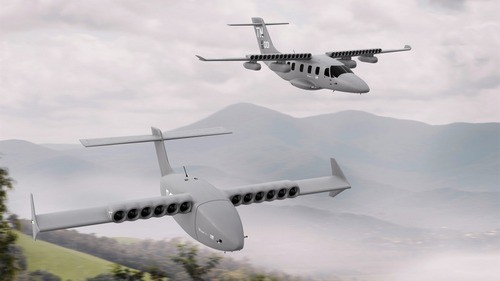
Whisper Aero Inc., a next-generation propulsion provider, unveiled a new family of systems for contested logistics known as Collaborative Logistics Aircraft (CLA) during Special Operations Forces (SOF) Week. Light (500 lbm payload) and heavy (3,000 lbm payload) variants of CLA were revealed utilizing Whisper's proprietary UltraQuiet™ propulsion and JetFoil™ integrations for conventional and short takeoff and landing (STOL).
Whisper's propulsion systems are the core enablers for these platforms. Multiple eQ250 propulsors, capable of 80 lbf of thrust, are integrated into the leading edge of the wings of these aircraft, in a concept known as JetFoil, to achieve coefficients of lift as high as 14, critical for short takeoff and landing from degraded runways. eQ250 propulsive efficiency improves at higher speeds, enabling higher speed flight of up to 250 kts with reduced acoustic and thermal signatures compared to existing turboprop or turbojet propelled aircraft. Static performance has been verified through tests with the Air Force Test Center (AFTC) at White Sands Missile Range's (WSMR) Acoustic Range Complex (ARC).
Whisper Aero has been selected for STRATFI and OECIF funding by the US Air Force to advance its CLA development. This comes after multiple years of maturing and validating its propulsion technologies together with AFWERX and the Air Force Research Lab (AFRL) on prior small business contracts. Together with the Air Force, Whisper is taking a crawl, walk, run approach that successively builds towards the largest aircraft in the CLA family of systems.
First, Whisper is leveraging its Ultralight, a retrofitted Swift3 glider with two eQ250s to gather flight test data and advance the thrusters to technology readiness level (TRL) 7/8. Whisper recently announced a $500K effort by the State of Tennessee in conjunction with Tennessee Tech to accelerate this effort. After successful civil flight tests, the team expects to advance to testing with the Air Force Test Center at White Sands Missile Range's Acoustic Range Complex in 2026.
Once the Whisper Ultralight is airborne, the engineering team will set its sights on the CLA Light, a 1,300 lbm Group 3 UAS capable of carrying 500 lbm payload over 200 NM or ferrying over 2,000 NM with no payload. The CLA Light is a clean sheet design leveraging JetFoil arrays of twelve eQ250 on its main wing to enable CTOL or STOL with a 50 ft takeoff/landing ground roll. Its long range and STOL capabilities are enabled by a 40 kW powerplant and a small battery and can dash at 175 kts. The nose easily opens to reveal an accessible payload bay for cargo specialists to load and unload necessary supplies. The team expects flight tests for this aircraft to begin in 2027.
Over the next four years, Whisper Aero will be focusing its air mobility efforts on rapidly designing, building, and flying multiple full-scale CLA variants with the intention of bringing this capability to service on a program of record. The designs of these aircraft, their propulsion systems, their manufacturing plans, and prototype builds will be covered through Whisper's DoD contracts. Flight testing will begin through funded internal R&D before transitioning to funded DoD flight experimentation and exercises.
Airbus introduces uncrewed version of the H145, the U145
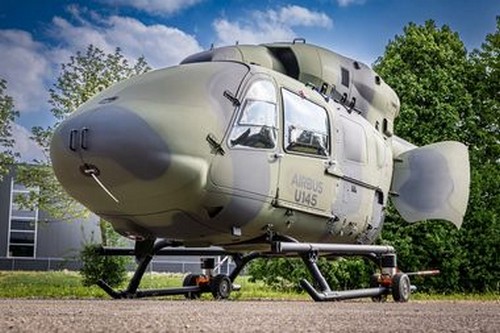
Airbus Helicopters has introduced an uncrewed version of its proven H145, the U145, during ILA Berlin airshow, where the company has displayed a full-scale mock-up of the new model. The U145 complements Airbus' helicopter and uncrewed aerial systems (UAS) offering. A maiden flight with a safety pilot onboard is planned for the end of 2026, with entry into service at the beginning of the next decade.
“With the U145, we are offering our customers an autonomous, uncrewed version of our H145 helicopter - combining the proven airframe, power and useful load of the H145 with the autonomy of a UAS,” said Matthieu Louvot, CEO of Airbus Helicopters. “To develop the U145 and its capabilities as a multi-mission UAS, we will be teaming up with leading autonomous mission partners to further expand the UAS ecosystem in Europe,” he added.
The H145 is the second crewed helicopter Airbus is converting into an uncrewed version, following the VSR700, which is derived from the Cabri G2. The U145 will feature a specialised sensor suite and artificial intelligence for full autonomy. Compared with a crewed H145 helicopter, the U145 will have no physical cockpit, and will include significant adaptations for cargo, such as an integrated nose door including a foldable loading table and a dedicated cargo floor.
With a Maximum Take-Off Weight (MTOW) of 3,800 kg, the U145 is being developed as a mission-agnostic solution for civil and military applications, primarily high-volume cargo supply. Its modular design supports expansion into roles like disaster management, firefighting, armed scouting, surveillance, drone mothership functionality for air launched effects, where Airbus is partnering with MBDA, as well as crewed-uncrewed teaming.
In the United States, Airbus U.S. Space & Defense is, together with its partners Shield AI, L3 Harris and Parry Lab, offering the US Marine Corps a dedicated US development, the MQ-72C, which is a fully autonomous variant of the well proven Lakota UH-72B, tailored to their specific needs.
In total, there are more than 1,800 H145 family helicopters in service for military, parapublic and civil missions, logging a total of more than 8.5 million flight hours. Powered by two Safran Arriel 2E engines, the H145 is equipped with a full authority digital engine control (FADEC). Its particularly low acoustic footprint makes the H145 the quietest helicopter in its class, while its CO2 emissions are the lowest amongst its competitors.
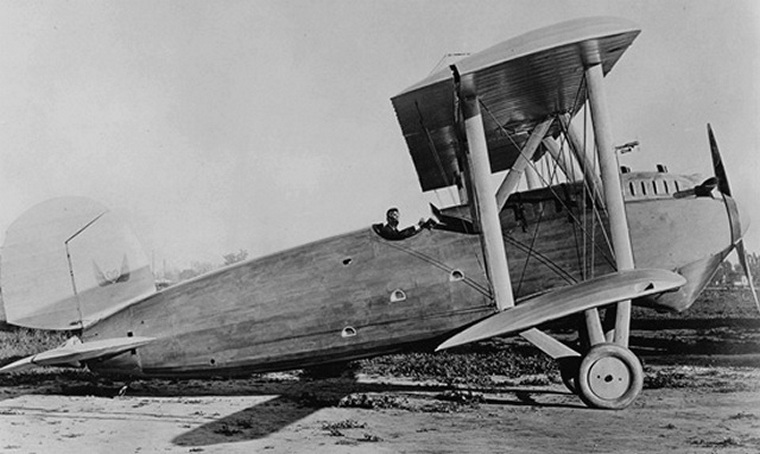
The Davis-Douglas Company was formed in July 1920 to enable Donald Douglas to design and build an aircraft capable of non-stop flight coast-to-coast across the United States. David R. Davis provided the financing for the company. The resulting aircraft was the Cloudster, a single-bay equal-span biplane of wooden construction. It was fabric-covered except for the forward fuselage, which was covered with sheet metal. The aircraft was powered by a 400 hp (298 kW) Liberty V-12 piston engine.
In 1923, the Cloudster was sold and modified for sightseeing flights with two additional open cockpits and seats for five passengers replacing one of the fuel tanks. In 1925 it was again sold to T. Claude Ryan, who had it modified further by adding an enclosed cabin with ten seats. It was subsequently used by a number of operators before it made a forced landing in shallow water off the coast of Ensenada, Baja California in December 1926. It was damaged beyond repair by the tide before it could be recovered.
Dominican Republic, La Romana International Airport (LRM/MDLR), La Romana: A Gulfstream G200, N318JF, was destroyed when it crashed during an attempted emergency landing on runway 29 at La Romana International Airport (LRM/MDLR), Dominican Republic. Both pilots were killed. The flight crew reported an inflight emergency (appears to be a failure of one of the engines) and their intent to return back to the airport.ADS-B data indicate that the aircraft took off from runway 11 at LRM about 19:30 UTC, making a right hand turn until it flew a 300° track. At 19:35 it began two left-hand turns and appeared to be lining up for runway 11 for an emergency landing.AD-B data is missing for about four minutes and the aircraft was then tracked circling to the north-west of the airport. After completing four left-hand turns, the aircraft lined up for an emergency landing on runway 29. Weather data at the time of landing, 20:10 UTC, indicate am 8.7 kts tailwind component. Videos of the accident sequence appear to show the aircraft veering to the left after landing. The main undercarriage collapsed as the aircraft slid across the grass next to the runway. The no.1 engine can be seen separating from the fuselage. The aircraft the burst into flames when striking a runway sign.
Mexico, Mexico City-Benito Juárez International Airport (MEX/MMMX): Aeromexico flight AM702, a Boeing 737-852 (XA-JOY), and Air Canada flight AC994, a Boeing 737 MAX 8 (C-GMEX), were involved in a runway incursion incident at Mexico City (MEX). AM702 had left Terminal 2 and taxied via taxiway A and A1 to runway 05L for departure. The aircraft began a rolling take-off. Earlier, AC994 had left Terminal 1 and followed taxiway B to the departure runway. The aircraft stopped close to taxiway B5 at12:31 UTC.At 12:46 UTC, as AM702 was accelerating down the runway, AC994 turned onto B5 and entered the active runway 05L, taxiing towards AM702. Aeromexico 702 aborted the take-off and vacated the runway. The flight departed 18 minutes later.AC994 vacated the runway as well and taxied to a remote parking spot. When AM702 aborted the take-off, the distance between the two aircraft was about 800 meters.