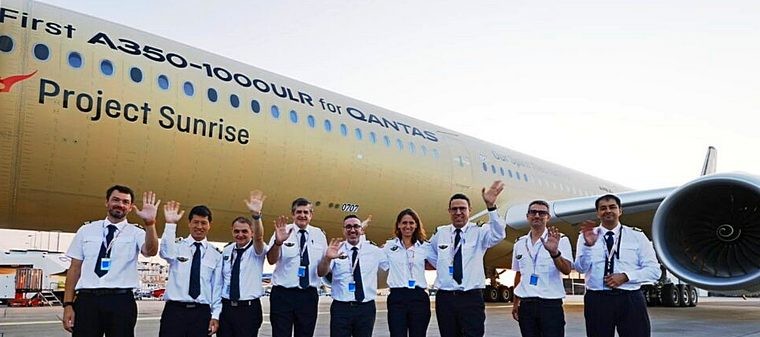
An Airbus A350-1000ULR, bearing the test registration F-WULR (MSN 707), has completed a remarkable second leg of its world-spanning certification tour. After successfully completing a direct 19-hour 12-minute flight from Airbus headquarters in Toulouse, France, to Melbourne, Australia, the twin-engine jet departed Melbourne on Monday, 27 July, on an extraordinary return journey to France.
The aircraft was flown by Airbus Experimental Test Pilots Thomas Wilhelm and Anthony Flynn, together with Test Flight Engineer Laurent Rossignol. Also onboard were Lead Flight Test Engineers Tuan Do and Alexia Plumet, as well as Ground Test Engineer Vincent Frayssinet.
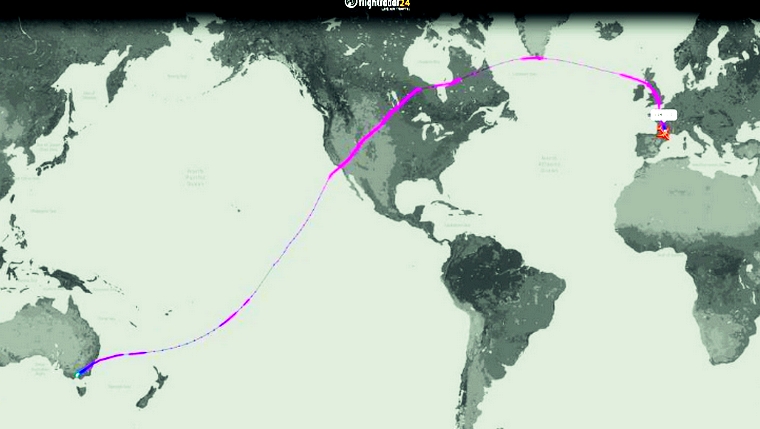
Rather than retracing its route across Asia, the test aircraft embarked on an eastbound circumnavigation. From Melbourne it headed across the Pacific towards the west coast of the United States, continued across North America and then crossed the Atlantic before returning to Europe and Toulouse.
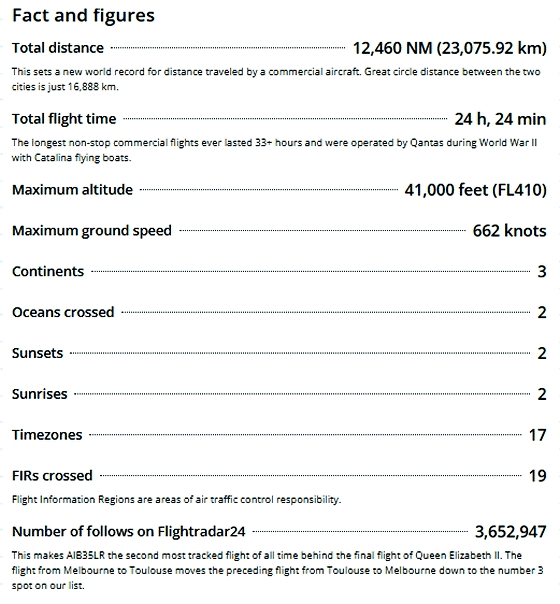
The extraordinary flight lasted 24 hours and 24 minutes, covering approximately 23,075 kilometres non-stop. In doing so, the A350-1000ULR surpassed the previous endurance record for a commercial-type airliner, set in 2005 by a Boeing 777-200LR, which had flown 21,601 kilometres non-stop from Hong Kong to London in 22 hours and 42 minutes.
The flight produced another remarkable statistic. About three hours after departing Melbourne, the aircraft was recorded at a ground speed of 662 knots (1,226 km/h) while flying over the South Pacific. Although this figure is greater than the commonly quoted sea-level speed of sound, the A350 itself was not flying supersonically. The extraordinary ground speed was the result of a powerful high-altitude jet stream providing the aircraft with an exceptionally strong tailwind.
The A350-1000ULR, the ultra-long-range variant of Airbus' successful A350 family has been specifically developed for Qantas Airways' ambitious Project Sunrise programme. Its purpose is to make possible non-stop flights from Sydney to London and New York, with flight times of up to around 22 hours.
To achieve a range exceeding 18,500 kilometres (nearly 10,000 nautical miles), Airbus engineers have fitted the ULR variant with an additional 20,000-litre Rear Centre Tank (RCT). The additional fuel capacity is essential for the extreme range required by Project Sunrise.
The aircraft also incorporates a range of modifications aimed at making ultra-long-haul flights more practical for passengers and crew. Its flight-test programme includes extensive monitoring of fuel systems, cabin conditions and passenger-wellness considerations, with more than 1,000 sensors and instrumented test equipment being used during development.
The Project Sunrise aircraft will eventually fly passengers on journeys of almost a full day. Qantas has therefore placed considerable emphasis on passenger wellbeing, including cabin lighting designed to assist with circadian rhythms, carefully timed meal services and a dedicated wellness zone where passengers will be able to move around and perform guided exercises.
The first commercial Project Sunrise service is scheduled to be the Sydney-London route, expected to commence in October 2027, with Sydney-New York services expected to follow later that year. Qantas has ordered 12 specially configured A350-1000ULRs for the programme.
The Airbus passenger line-up will soon be joined by the all-new A350F freighter, which is also under development at Airbus, with its first flight planned for later this year.
At the end of April 2026, the A350 Family had accumulated 1,579 orders from 68 customers, with more than 700 aircraft already in service with 41 operators. The family has established itself as one of the world's leading long-haul airliner programmes.
With the A350-1000ULR, Airbus is taking that capability a remarkable step further. The Melbourne-Toulouse proving flight demonstrated not only the aircraft's extraordinary endurance, but also the technology and operational preparation required to make flights lasting 20 hours or more a reality for airline passengers.
AirVenture 2024 Istanbul Türkiye to Chicago USA 80