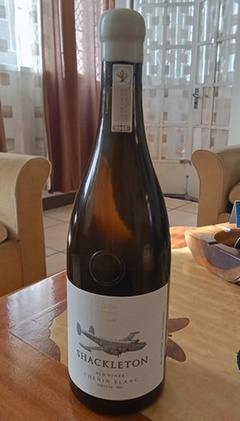
A week or so ago, I received a call from my friend Leon du Plessis asking if he could pop in to show me a bottle of wine he had been given while visiting his sister.
The bottle had an interesting history.
Living in the same complex as Leon's sister is retired SAAF General James Wallace. Many years ago, while holidaying in Franschhoek, close to the crash site of an SAAF Avro Shackleton, General Wallace had purchased a bottle of wine associated with the aircraft. The bottle was unopened when he kindly gave it to Leon.
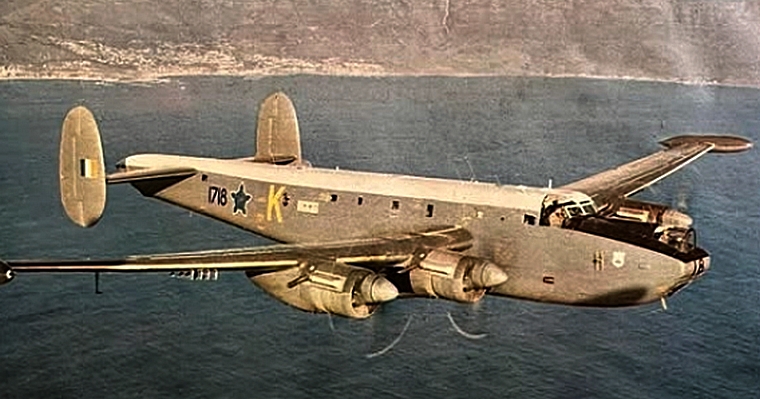
Naturally, I wanted to know more. That bottle of wine led me to revisit the tragic story of Shackleton MR.3 1718 and the 13 men who lost their lives when the aircraft crashed in the Stettynskloof Mountains on 8 August 1963.
The flight
The story began on 8 August 1963 when the crew of Shackleton 1718 was briefed at Air Force Station (AFS) Ysterplaat for a flight to an exercise area involving elements of Britain's Royal Navy, the South African Navy and the SAAF.
During the briefing, the Operations Officer instructed the Shackleton crew to head out over False Bay after take-off and then proceed seawards towards the exercise area. The crew was specifically warned to avoid the direct overland route towards Port Elizabeth because high icing levels were expected along that route.
The seaward route would also reduce the risk of the aircraft inadvertently flying into high ground in conditions of greatly reduced visibility.
When the aircraft commander, Captain Thomas Howard Sivertsen, conducted his own briefing, he confirmed the planned route south over False Bay and then seawards towards the exercise area.
There were already serious concerns about the weather. The Flight Office at Ysterplaat telephoned the Maritime Group Operations Centre three times before the Shackleton departed, requesting that the flight be cancelled. The request was not granted.
Just minutes before take-off, however, Captain Sivertsen informed Air Traffic Control that he intended climbing to 2,896 metres (9,500 ft) AMSL and routing overland towards Port Elizabeth.
Shackleton 1718 was considered fully serviceable for flight. Although its compasses had not been swung on their normal expiry date of 19 July 1963, Maritime Group had authorised a one-month extension, provided that no major part of the aircraft was replaced. The compasses were therefore considered serviceable.
At approximately 15H06, Shackleton 1718 departed from Runway 34. The weather was deteriorating rapidly.
Shortly after take-off, Air Traffic Control advised the aircraft that it was off course and instructed the crew to avoid Tiger Mountain. The warning was acknowledged and the aircraft altered course. About a minute later, the crew requested clearance to resume its original course. This was the last radio transmission received from the aircraft before its final mayday call.
At about 15H20, the radar technician at DF Malan requested permission to deactivate the radar for approximately ten minutes because the radar installation was being flooded by the heavy rain. Permission was granted.
Before the radar was switched off, however, Shackleton 1718 was showing on the radar at a distance of approximately 40 km (25 miles) on a course of 100 degrees. Its actual ground course was approximately 145 degrees.
The search
Although there was growing evidence that the aircraft had crashed, most likely somewhere in the Stettynskloof/Wemmershoek Mountains, the atrocious weather conditions and the lateness of the hour prevented any meaningful search-and-rescue operation from being mounted that day.
On 9 August, helicopters were dispatched to the Wemmershoek area to assess the weather, but conditions remained completely adverse.
Following a report that an aircraft had been heard, another helicopter was sent to search the mountains south of Simonstown.
On 10 August, the search continued. One helicopter searched in the Simonstown area while another aircraft was sent to assess the weather in the Wemmershoek area.
The wreckage was finally located from the air more than two days after the accident.
It was immediately apparent from the almost complete destruction of the aircraft that there could have been no survivors.
The investigation
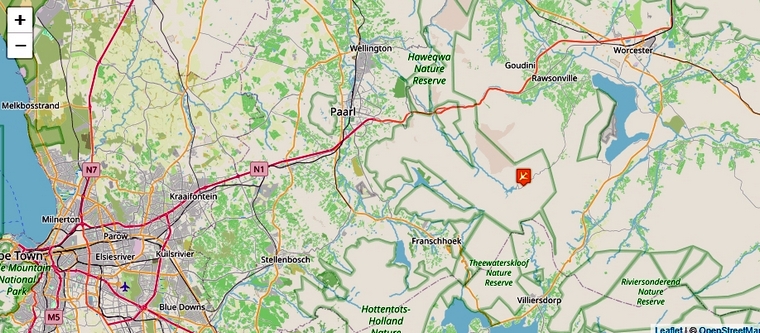
The crash site was approximately 25.8 km (16 miles) from Worcester, in the Stettynskloof valley.
After inspecting the wreckage, the 35 Squadron Engineering Officer, Captain W. J. Stiglingh, decided to investigate two particularly significant failures: the port elevator and the upper section of the starboard rudder, both of which had detached from the aircraft in flight.
The section of the starboard rudder was found 1,620 metres (5,314 ft) from the main impact point, while the port elevator was located 1,250 metres (4,100 ft) away.
The evidence indicated that the two flight-control surfaces had separated from the aircraft before the main impact. Their loss would have rendered the Shackleton uncontrollable.
At some stage during the sequence, the pilot made a final mayday transmission.
The Board of Inquiry established that the impact speed was high and that the combination of the high-speed impact and the resulting fire caused almost complete destruction of the aircraft.
There was no evidence of any attempt by the crew to use parachutes, and all 13 occupants were assumed to have died in the extremely high-G impact.
The weather
The Board found that the atrocious weather was a significant contributory factor in the accident.
Winds were reported at approximately 148 km/h (92 mph), associated with an unstable air mass producing strong convection currents. Cloud cover extended from approximately 305 metres (1,000 ft) to 8,841 metres (29,000 ft) AMSL, accompanied by heavy precipitation.
Because of the turbulence, moist unstable air mass and low icing height, unusually severe icing conditions existed between approximately 1,220 and 1,829 metres (4,000-6,000 ft).
The Board also noted that the maximum permitted acceleration for the Shackleton airframe was only 2.4 G. Under the exceptionally turbulent conditions encountered on the flight, it was theoretically possible to exceed this limitation relatively easily.
The combination of heavy icing, violent and turbulent winds, the considerable weight of the aircraft and possible over-control by the pilot placed exceptionally high loads on the airframe.
An avoidable accident
The Board of Inquiry found Captain Sivertsen solely responsible for the accident.
It concluded that he had displayed a complete lack of discipline by disobeying the direct instruction to route south over False Bay and instead choosing to fly overland, where the mountainous terrain greatly increased the dangers posed by the already appalling weather.
The aerodynamic effects of heavy icing, strong and turbulent winds, the aircraft's heavy weight and possible over-control resulted in loads exceeding the airframe's design limitations.
The subsequent structural failure, beginning with the separation of the flight-control surfaces, led to loss of control and the fatal crash.
The accident was therefore classified as an avoidable major flying accident.
The only SAAF Shackleton lost during service
The loss of 1718 was particularly significant because it was the only SAAF Shackleton to be written off during the aircraft's 27 years of SAAF service, from 1957 until 1984.
Eight Shackleton MR.3s were acquired by the SAAF, and the type became one of the country's most important maritime patrol aircraft. 1718 had been manufactured in 1957 and had accumulated approximately 777 flying hours by the time of its loss.
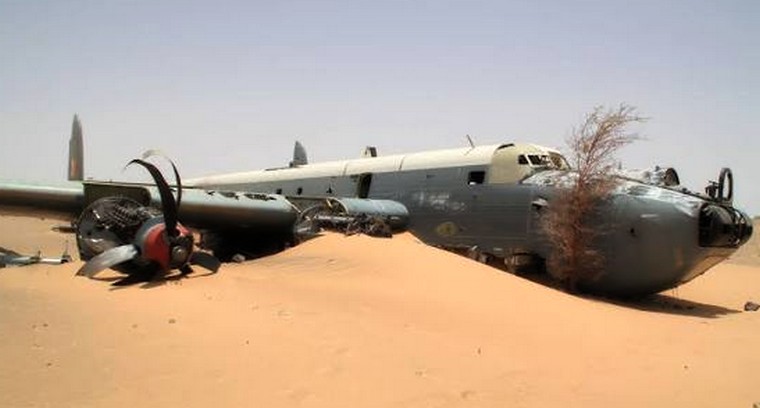
Another aircraft, 1716, named Pelican, had a very different fate. After retirement from SAAF service, it was restored to flying condition and, in 1994, was being flown to the United Kingdom when engine failures forced it to make an emergency landing in the Sahara near the border with Mauritania. Fortunately, there was no loss of life among the 19 people aboard.
Today, the story of Shackleton 1718 survives not only in the records of the SAAF and the memories of those who knew the men involved, but also, unexpectedly, on a bottle of wine.
And that is how a bottle of wine led me to rediscover one of the SAAF's most tragic aviation stories.