This Week in Midweek Updates
Aviation101's this Is Africa: Part 1, the adventure begins!
Oshkosh Airventure 2027.
AAD 2026 -Africa's gateway to the global defence and aerospace collaboration.
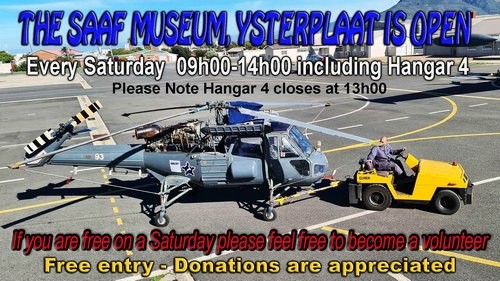
South African Air Force Museum, Ysterplaat open on any Saturday.
Cape Town integrates drones into citywide public-safety intelligence network.
First fully UK-built Islander since repatriation of production begins ground testing ahead of first flight.
ShadowfaxUAS unveils SF45 VTOL fixed wing UAV, its answer to a highly contested global market.
APOSA Tri-Monthly Update (August 2026).
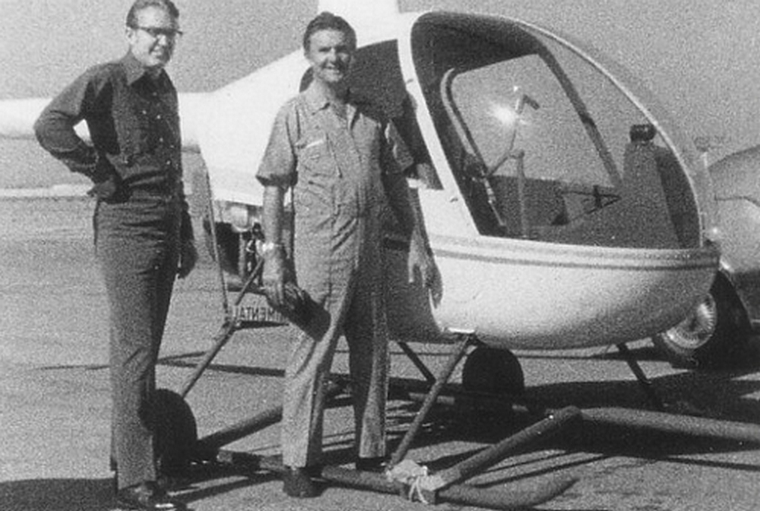
This week in history - The Robinson R22 made its first flight on 28 August 28
Worldwide Incidents and Accidents
Bonus video - Baken Deuce A2A Shoot
Aviation101's This Is Africa: Part 1 The adventure begins!
A month. A fleet of gorgeous aircraft. One unforgettable adventure across Southern Africa with Josh Flowers, Chelsea Smith, their good friends Chris Lammert and Keelyn Costello, and some of us from Sling HQ.
In Part 1 of Aviation101's four-part series, the journey starts with their arrival in South Africa at Sling HQ in the south of Johannesburg, meeting the aircraft that will become their companions, ZU-TSI and ZU-DFU, and taking the first steps - or rather, first flights - into the unknown.
But this trip was never just about flying…
"We came to experience Africa from the ground as much as from the air - the landscapes, wildlife, food, people, culture, remote places, and everything that happens when you venture well outside the familiar," Josh says.
That is what makes this adventure different.
Over the next four episodes, Aviation101 will take us beyond the familiar, across extraordinary landscapes, into remote places and closer to the people, wildlife, culture and experiences that make Africa so unique. Because when you travel in a Sling, you don't simply get from one place to another. You experience the journey. You fly closer to the landscape. You reach places most travellers never see.
And this is only the beginning.
Watch This is Africa - Part 1 of 4 and join this group of amazing friends as the adventure takes flight!
After a busy AirVenture Oshkosh 2026, we are pleased to announce our itinerary for 2027, our 30th consecutive tour to the world's biggest aviation event!
Alpha, Bravo & Charlie Tours
Depart South Africa Friday 23rd July 2027
Return South Africa Tuesday 3rd August 2027
Alpha Tour ex Johannesburg
Single R43 900
Sharing R41 655
Bravo Tour ex Durban
Single R44 950
Sharing R42 680
Charlie Tour ex Cape Town
Single R45 350
Sharing R42 150
Delta Tour departs Terminal 5, O'Hare, Chicago Saturday 24th July at 17h00 and returns to O'Hare on Sunday 1st August 2027
Delta Tour
Single R17 250
Sharing R14 950
For more details please contact Neil +27 84 674 5674 or e mail info@airadventure.co.za
The SA campsite offers a convenient home for the week close to all the action, night and day!
AFRICA'S GATEWAY TO THE GLOBAL DEFENCE AND AEROSPACE COLLABORATION
AAD2026 AIRSHOW TICKETS
Now Open
Our much-anticipated Africa Aerospace and Defence (AAD) Airshow is now open to the public!
Showcasing cutting-edge technology and innovation in the aerospace and defence industries, this premier event, held at Air Force Base Waterkloof in City of Tshwane, South Africa, offers a unique opportunity for attendees to witness the latest advancements, thrilling aerobatics and displays of a diverse array of aircrafts.
The AAD airshow is a family-friendly event with activities and attractions for all ages. Children and adults alike can enjoy interactive exhibits, simulators and the chance to meet pilots and military personnel. Food stalls, merchandise vendors and entertainment options ensure a perfect fun filled outing for family and friends.
This year's air show promises an anticipated attendance of 65 000 spectators - so get your tickets early!
AAD2026 To Feature 3 Conferences In 3 Days
IT IS NOT JUST AN EXHIBITION; IT IS A PLATFORM THAT FOSTERS DIALOGUES ON DETECTION
Conferences are an important component of international aviation, defence and security exhibitions worldwide and the South African contribution, AAD, is no different.
PLATFORMS TO EXTEND YOUR BRAND VISIBILITY
AAD 2026 offers the platforms to extend your brand beyond the stand. Each reaches a distinct but complementary audience in hand and on screen. Giving you continuous brand visibility.
AAD 2026 SHOW DAILY
Produced by DefenceWeb
Published across three shows, the AAD 2026 Show Daily is the official daily print magazine of the exhibition - produced by DefenceWeb, Africa's leading defence news portal. For rates and availability, contact Robert Mace robert@defenceweb.com
AAD 2026 EXHIBITION CATALOGUE
Produced by Creative Space Media
The official AAD 2026 Exhibition Catalogue is the definitive reference document of the show - an A5, 150-page full colour publication distributed to 10,000 targeted delegates, including VIP delegation packs and media kits. For rates and availability, contact James james@creativespacemedia.co.za
South African Air Force Museum, Ysterplaat open on any Saturday
The Westland Wasp HAS Mk 1 were operated by 22 Squadron, from the modernised destroyers SAS Simon van der Stel and SAS Jan van Riebeeck, from the President class frigates, from the survey ship SAS Protea, and from the replenishment ship SAS Tafelberg. The first six Wasps began arriving in October 1963. In 1966, a second batch of 4 were received followed by a third and final batch of 6 Westland Wasps from the United Kingdom in 1976.
The Wasp is a naval anti-submarine helicopter capable of carrying two Mk44 torpedoes or Mk11 depth charges. It featured a castor undercarriage with four wheels that were rotated at 45º (to prevent the helicopter from rolling on a pitching and rolling flight deck), a folding tail boom, and short rotor blades for storage.
The Wasps took part in various humanitarian operations to search for lost weathermen on the remote Gough Island (in the South Atlantic) in July 1969, the rescue after the devastating earthquake at Tulbagh in September 1969, and the rescue of the crew of the oil tanker Kazimah (which ran aground off Robben Island) in November 1970. The Wasp on board the SAS Protea assisted with scientific visits to the Marion, Gough, and Kerguelen Islands as well as Antarctica.
This Westland Wasp HAS Mk1 93 was the first South African aircraft to fly at Antarctica in February 1978 from the SAS Protea.
To see this and 14 other aircraft plus all the history you must visit the South African Air Force Museum, Ysterplaat on any Saturday. Situated off Koeberg Road in Piet Grobler Street, turn right at the third robot coming off the N1. If not sure where we are, then best is to Google 'SAAF Museum, Ysterplaat', and it will take you directly to the museum. When passing through the base gate drive directly forward, the museum will be in front of you, but you will have to turn left and go around to the right to take you to the parking area. Contact Norman on 0836981943, or Blackie 082 319 1564, if you have a problem. IF YOU WANT TO VISIT THE MUSEUM DURING THE WEEK PLEASE PHONE 021 508 6692.
The museum is open for visitors of all ages, from 09ho0 till 14h00, every Saturday. Come early as we close the No3 and 4 hangars at 13h00. There is plenty to eat, the best boerie rolls and burger, as well as liquid
refreshments. We are card and wheelchair friendly.
Anyone who is free on Saturday mornings and bored at home, we have many activities, such as restoration, braaing and many other activities to occupy yourself alongside an awesome group of friends from 16 years up and with some golden oldies, females and males.
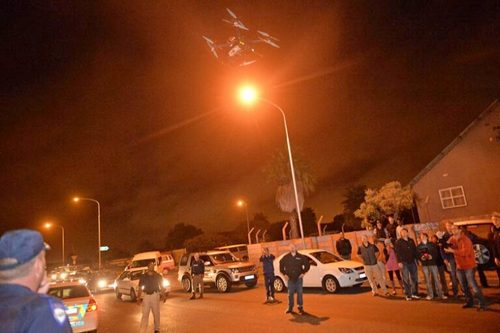
Cape Town Integrates Drones into Citywide Public-Safety Intelligence Network
By Dean Wingrin www.defenceweb.co.za Photo: Bruce Sutherland/City of Cape Town
The City of Cape Town is moving beyond treating Unmanned Aerial Systems (UAS) as standalone surveillance tools, integrating drone feeds with cameras, body-worn systems, automatic number-plate readers and other data sources to create a real-time operational picture.
The City's experience and vision for the use of UAS systems was described by Andrew Mortimer, Manager: Emergency, Policing Incident Command, Safety and Security Directorate at the City of Cape Town, who delivered a presentation on "UAS in Action: Advancing Public Safety Through Integrated Digital Twin and Command-and-Control Capabilities" at the Aeronautical Society of South Africa (AeSSA) annual conference in Stellenbosch in July.
Mortimer said Cape Town's scale and operational environment demanded technology that could convert information into decisions quickly. The City has more than 4.8 million residents and handles roughly 2 500 calls every 24 hours, with about 1 000 becoming incidents.
"The challenge is not collecting the information. The challenge is not generating the information. The challenge is how do we deal with it?" he told delegates. The objective, he said, was to transform data into "actionable decisions quickly enough to change outcomes".
Cape Town has accumulated substantial volumes of data through decades of investment in CCTV, computer-aided dispatch, digital evidence and body-worn cameras. The City has rolled out about 3 500 body-worn cameras, generating tens of thousands of video files daily.
Drones have become an important new sensor. During the 2025-26 financial year, Cape Town conducted 3 643 drone flights, with thousands focused on monitoring land-invasion hotspots. About 135 such areas are monitored monthly or every two months.
UAS are also used for fires, floods, search and rescue, crowd monitoring, tactical overwatch, officer safety and evidence collection. During search-and-rescue operations, drones can travel ahead of ground teams and provide commanders with an aerial safety view.
Mortimer highlighted the value of combining sensors. In one incident involving a vehicle on one of the City's highways, information was simultaneously available from a drone, CCTV camera, officer body camera and vehicle dash cameras. The network provided situational awareness and evidence.
He described an incident in which a drone operator warned commanders on the ground against advancing a police unit down a road because a group was positioned in a side alley, ready to attack them from behind once the unit proceeded ahead. The aerial view helped prevent a potentially serious ambush.
"The drone itself is not the capability," Mortimer stressed. "The capability is the intelligence generated by the tools."
Cape Town is developing what Mortimer described as its first operational public-safety digital twin: a live common operating picture integrating incidents, resources, risks and operational context.
The digital twin represent a real-time digital map of the City's public-safety environment, bring together drone and CCTV feeds, body cameras from officers in the field, automatic number-plate recognition, emergency incidents and dispatch information, GIS mapping and geographic data, locations of officers and other resources, together with operational information from partner organisations.
For example, instead of a drone operator seeing a suspicious vehicle and reporting "there's a vehicle here", the digital twin could show the vehicle's location alongside nearby CCTV cameras, the location of police units, the relevant incident, road information and other available intelligence. The commander can therefore make a decision based on the context surrounding the drone's observation.
The system currently displays 850 objects on a single live map, using a 24-hour rolling real-time situational picture.
The next stage is an integrated safety and security fusion centre, rather than a standalone drone operations centre. Drone feeds will sit alongside CCTV, body-worn cameras, incident systems, traffic information and other intelligence sources.
He also stressed that UAS should not be viewed as replacements for manned aircraft. A manned aircraft can remain airborne for six to eight hours and rapidly reach distant incidents, day or night, while drones offer faster deployment for localised events. "They are distinctly different tools," he explained.
For the aviation industry, Mortimer's message was blunt: Cities will judge UAS providers on outcomes, not flight hours. Integration with command structures and ground forces matters more than simply putting more aircraft into the sky.
The longer-term objective is autonomous, beyond-visual-line-of-sight operations, potentially using strategically positioned drone docks or tethered systems to respond within minutes to emergencies.
"Tech doesn't solve problems by itself," Mortimer said. The combination of people, processes, data and partnerships, he argued, is what turns technology into public-safety capability.
Cape Town is leading South African cities in the use and integration of UAVs in the safety and security environment, transitioning from incident response to making aerial intelligence an integral part of a connected public-safety system.
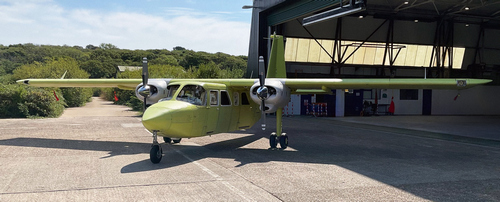
First Fully UK-Built Islander Since Repatriation of Production Begins Ground Testing Ahead of First Flight
The first Islander to be fully built in the UK since Britten-Norman repatriated production to Bembridge has begun its ground test programme, with first flight targeted for September. Delivery to the Falkland Islands Government Air Service (FIGAS) will follow completion of flight testing and customer preparation, and the company is opening its production line to customers and media ahead of the aircraft's formal launch later this year.
The aircraft was rolled out at the company's Isle of Wight facility on Thursday 30th July, the day after electrical power was successfully applied for the first time. The roll-out followed the installation of the aircraft's engines, propellers, cowlings, electrical systems, brakes and flight control surfaces and mechanisms, and came in sequence with the programme's previous public milestones: 75% structural completion confirmed in June, power-on on 29th July, and roll-out the following day.
The aircraft is the first Islander to be fully assembled through Britten-Norman's reshored UK production line, marking the return of complete civil Islander manufacturing to the United Kingdom following a period in which major assemblies were manufactured overseas prior to final assembly in the UK.
Behind this aircraft, the production line is already at work. A second airframe is progressing through the line, components for follow-on aircraft are in manufacture, and the company is establishing a continuous production cadence at Bembridge, supported by investment in new machinery, tooling and facilities and a workforce that has grown by more than 40% since production was reshored.
The new-build aircraft retains the qualities that have kept Islanders in service worldwide for more than five decades: low operating costs, rugged reliability and unmatched short-strip performance, now delivered through more modern manufacturing methods and tooling. This aircraft is built to the same standard its operators have always relied upon, an airframe with a proven track record of 50 years of service life.
Duane Stewart, General Manager of the Falkland Islands Government Air Service, said, "We're delighted to see this new aircraft taking shape and look forward to welcoming it to the Falkland Islands. We're incredibly grateful to Britten-Norman for their continued support and the strong relationship we have built over the decades. This new Islander will be a valuable addition to the FIGAS fleet and help us continue providing an essential service to our community for years to come."
"The roll-out of this aircraft is a hugely significant moment for the whole Britten-Norman team, and we want to share it," said Richard Milne, Chief Operating Officer at Britten-Norman. "To see the first Islander from our repatriated UK production line come together, from producing and sourcing the many parts to roll-out, is testament to the skill and commitment of everyone at Bembridge. We are now firmly focused on completing ground testing and preparing for first flight. The line is running, a second aircraft is taking shape behind this one. Customers and media are very welcome to visit Bembridge and see the aircraft and the production line for themselves ahead of the formal launch later this year."
Peter McKenna, owner of Aer Arann, said, "Having been an Islander operator for more than 56 years, we are thrilled to see new Islanders coming off the line at Bembridge. Nothing rivals the rugged reliability of the Islander, and our fleet is testament to that. We look forward to continuing our relationship with Britten-Norman for many more years to come."
Shadowfaxuas Unveils SF45 VTOL Fixed Wing UAV, Its Answer to a Highly Contested Global Market
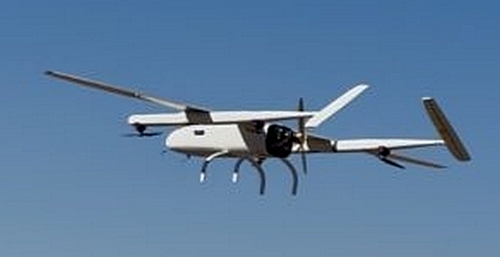
ShadowfaxUAS has officially launched the first and largest of its three latest-generation unmanned aerial vehicles (UAVs), the SF45. Building on the company's earlier SF30 UAV, the long-endurance Group 3 fixed-wing VTOL (Vertical Take-Off and Landing) UAV represents a significant step forward for the South African unmanned aerial systems manufacturer, offering a heavier-payload and longer-range capacity for persistent intelligence, surveillance, and reconnaissance (ISR) operations.
Speaking to DefenceWeb, ShadowfaxUAS explained that the redesign was primarily driven by geopolitics. "The main driver was the changing international geopolitical environment, as a result of the war in Ukraine and increased international polarisation," the company said. The increasing international divide between the West and China, Russia, and Iran, it explained, "led to the realisation that Western countries were relying on Chinese manufacturing, and that they did not have manufacturing capability."
Subsequent American bans on Chinese drones and components, such as T-Motor components and DJI drones, coupled with changing US and European requirements for Chinese-free critical components, led to the realisation that a complete redesign would be necessary, ShadowfaxUAS explained.
Seeing this as an opportunity, the company decided that rather than simply focusing on eliminating critical Chinese components, it would instead opt to go further and revisit its "analysis of the functional requirements that the platform had to fulfil."
"We realised that customers requiring persistent surveillance capability naturally fell into one of two categories: those that were satisfied with a relatively lower specification payload, and those who either were developing their own heavier payloads or who wanted the capability to be able to carry heavy or multiple payloads," the company explained.
Subsequently, and over the course of two years, ShadowfaxUAS developed two different long-endurance platforms. The SF45 was developed as a heavier-payload Group 3 platform alongside the yet-to-be-launched SF25, a smaller Group 2 offering which will be available with interchangeable electric and gasoline propulsion formats.
Founded in 2020, the Cape Town-based company is an independent, privately owned and funded UAV manufacturer under the leadership of CEO Liezl Beyers and Technical Director Johan Beyers, joined by their son, a mechatronic engineer in the development team. For this reason, the company has retained in-house control over the entire development and production cycle, from airframe design to composite manufacturing, avionics integration and testing.
"The ethos of the company flows from the professional history of the directors and is focused on stewardship," ShadowfaxUAS told DefenceWeb, emphasising that "The goal is to provide customers with a tailor-made solution and to support the customer throughout the UAV life cycle."
As a Group 3 UAV, the SF45 has a 40 kg maximum weight, a maximum 8 kg payload capacity and a 4.3 metre wingspan. The aircraft has a datalink range of up to 150 km. When carrying a 1.5 to 3kg payload, the aircraft has a maximum 10-hour flight endurance, depending on configuration, enabling a sortie range of over 1 000 km at a maximum altitude of 3 000 metres.
"The SF45 duration figure is conservative. We are constantly optimising the performance of the platform to further increase duration and payload capacity, and are confident that the SF45's duration will ultimately exceed 10h and probably end up, depending on payload carried, at 12-13h," the company clarified.
ShadowfaxUAS SF45 on the ground. Photo: ShadowfaxUAS
A key hallmark of this generation of ShadowfaxUAS UAVs is their patented quick-swap forward propulsion system. This innovative feature serves to drive down maintenance time and cost while also improving reliability and availability, the company explained.
"This allows the entire propulsion unit to be swapped out, in the field, in less than a minute, which maximises platform availability and utilisation, and which also allows the propulsion unit to be easily maintained in a workshop environment," the company said, adding, "easy routine maintenance translates into higher reliability, platform availability and, in turn, lower cost per sensor hour. It also reduces the number of UAVs, and capital cost, required to meet a particular persistent surveillance requirement."
In addition, the SF45 also employs ShadowfaxUAS's patented payload balancing technology which maximises duration by eliminating the need for ballast while enabling easy payload exchanges in the field.
With the SF45 utilising a gasoline propulsion system, a key part of the company's drive to minimise maintenance costs while maximising video quality has been to isolate sensitive electronics from the negative effects of persistent vibration.
"We invested significant development effort and expense in achieving very low vibration levels on our platforms through the development and implementation of a proprietary vibration isolation engine mount system which has reduced vibration on our platforms to negligible levels," the company explained, adding, "this results in increased flight controller precision, improved video feed quality and increased reliability and electronic component lifetimes."
While the SF45 has been primarily designed around ISR operations, ShadowfaxUAS notes that the UAV's agnostic payload design means it can be configured for a wide range of use cases. Custom payload integrations are possible due to the company's full-stack in-house capabilities.
While obvious use cases include battlefield ISR, communications relay, signals intelligence and maritime patrol and surveillance, as well as counter-poaching and counter-insurgency operations, the SF45 can also be used in a range of alternative settings, such as mining, agriculture, and conservation, where it can monitor far larger areas than multi-copter UAVs.
The SF45 is ITAR (International Traffic in Arms Regulations [United States]) free. "Many of our competitors in the Group 3 market are ITAR restricted, which severely constrains their ability to export from the USA and largely limits the sales to close allies and partners under rigorous government licensing or foreign military sales processes," the company said, adding, "we are able to fill that gap by providing UAVs with comparable capability and quality." ShadowfaxUAS noted that the SF45 is also competitively priced when compared to premium Western systems of similar mission capability.
While ShadowfaxUAS remains a largely export-focused company, the company told DefenceWeb it will be approaching the South African Civil Aviation Authority for safety approvals in the next few months, enabling South African customers to acquire and operate the company's UAVs.
Over the course of the next several months, and once the requisite performance validation testing has been completed, ShadowfaxUAS's product range is set to be expanded with the expected launch of two smaller Group 2 fixed wing VTOL UAVs, the SF25E and SF25G. Like the SF45, these UAVs have been developed entirely in-house and are set to offer clients a durable, reliable, yet cost-effective solution for their operational needs.
"We have purposely developed robust, reliable UAVs, that, in conjunction with training on our proprietary simulator, make using them in difficult terrain as easy and cost effective as possible for the client," ShadowfaxUAS emphasised.
The Robinson R22 made its first flight on August 28, 1975
01A Designed by Fank D. Robinson the R22 received Federal Aviation Administration (FAA) certification in March 1979. It's Impact changed civilian aviation by making helicopter flight training affordable and it spawned the now famous line of helicopters at the Robinson Helicopter Company.
Congo, Bikuba, near Minembwe: An Antonov An-28 plane was reportedly shot down by a drone from the FARDC (Forces Armeés de la République Démocratique du Congo) in an area controlled by anti-government forces, resulting in the deaths of 4 people. The aircraft is said to have come down in the highlands of the Fizi territory, in South Kivu. Photos, purportedly from the wreckage of the aircraft, suggest it was an An-28 that was previously seen operating in the area, controlled by the Rwanda-backed AFC/M23 armed group.
South Africa: Rand Airport (QRA/FAGM), Germiston, Gauteng: Flying Lions Aerobatic Team Canadian Car & Foundry T-6H Harvard IV, ZS-BVK "#5", ground looped when landing at Rand Airport (QRA/FAGM), Germiston, Gauteng. No reported injuries and the aircraft received substantial damage.
Hungary, near Gerjen: A 24-year-old man stole a Cessna 172N Skyhawk (Reims, CD135 diesel mod.) from Kalocsa-Fokto Airfield (LHKA) and took off without authorization. The aircraft reached the area of the Parks Nuclear Power Plant, where it performed prohibited maneuvers in a no-fly zone. Hungarian military radars detected him, and two Gripen fighter jets were scrambled to intercept it. Subsequently, the pilot made an emergency landing in a sunflower field near Gerjen. The aircraft was reportedly damaged during the landing, with its landing gear broken with the plane coming to rest on its wing, tilted to one side. The man then left the plane and walked along the road in a distraught state, and was later arrested. According to the police the suspect sustained no injuries.